BioGuard Banish is a granular stain remover that eliminates metal stains from pool surfaces caused by iron, copper, and manganese. Add 1 to 2 pounds per 10,000 gallons directly to stained areas, brush vigorously, circulate 24 hours, then vacuum. Works best with balanced pH 7.2 to 7.6. This guide covers complete stain removal procedures, prevention strategies, and troubleshooting for maintaining stain free pool surfaces.
Table of Contents
What is BioGuard Banish?
BioGuard Banish is a professional grade granular stain remover specifically formulated to eliminate metal stains from pool surfaces. This powerful treatment removes unsightly brown, green, blue, and black stains caused by iron, copper, and manganese deposits, restoring your pool's appearance without draining or acid washing.
Key Features of BioGuard Banish
- Removes metal stains: Eliminates iron, copper, and manganese staining
- Granular formula: Easy to apply directly to stained areas
- Fast acting: Visible results within 24 to 48 hours
- No draining required: Treats stains without emptying pool
- Safe for all surfaces: Works on plaster, vinyl, fiberglass, and tile
- Professional strength: Used by pool service professionals
- Concentrated formula: Effective at low dosages
- Prevents stain return: When used with metal sequestrant
How BioGuard Banish Works
Banish uses reducing agents to chemically convert oxidized metal stains back into soluble form, allowing them to be filtered out of the water or sequestered to prevent re-staining. The granular formula allows direct application to stained areas for targeted treatment.
When combined with proper weekly pool cleaning routines and preventive maintenance, BioGuard Banish helps maintain stain free pool surfaces.
Identifying Pool Stains
Common Types of Metal Stains
Iron Stains (Brown, Rust, or Reddish):
- Most common type of metal stain
- Appears as brown, rust colored, or reddish marks
- Often appears after shocking or adding chlorine
- Caused by iron in fill water or corroded equipment
- Typically appears on walls, floor, and steps
Copper Stains (Blue, Green, or Teal):
- Appears as blue, green, or teal discoloration
- Common in pools with copper based algaecides
- Can result from copper plumbing or heaters
- May appear after low pH conditions
- Often concentrated in specific areas
Manganese Stains (Purple, Black, or Dark Brown):
- Appears as purple, black, or very dark brown stains
- Less common than iron or copper stains
- Usually from well water or certain fill water sources
- Can be mistaken for algae or dirt
- Often appears after oxidation from chlorine
Stain Testing Methods
Vitamin C Test (Ascorbic Acid Test):
- Hold vitamin C tablet against stain underwater
- Rub gently for 30 seconds
- If stain lightens or disappears, it's a metal stain
- If no change, may be organic stain or algae
- This confirms Banish will work on the stain
Visual Inspection:
- Metal stains have defined edges and patterns
- Organic stains are usually fuzzy or slimy
- Metal stains don't brush off easily
- Stains that appeared after adding chemicals are likely metal
Before You Begin: Preparation
Pre Treatment Checklist
- Identify stain type using vitamin C test
- Calculate pool volume accurately
- Test and record water chemistry
- Clean filter before treatment
- Have metal sequestrant ready for after treatment
- Plan for 24 to 48 hour treatment period
- Ensure adequate Banish product for stain severity
- Have pool brush and vacuum ready
Water Chemistry Requirements
Balance water chemistry before treating stains:
- pH: 7.2 to 7.6 (critical for stain removal)
- Total Alkalinity: 80 to 120 ppm
- Free Chlorine: Lower to 1 ppm or below before treatment
- Calcium Hardness: 200 to 400 ppm
- Water temperature: Above 60°F for best results
If pH is high, learn what to do if pH level is high and how to reduce pH levels.
Safety Precautions
- Wear gloves and safety goggles when handling
- Do not mix with other chemicals
- Store in cool, dry location
- Keep away from children and pets
- Avoid breathing dust
- Wash hands after handling
- Do not add to skimmer or chlorinator
Step by Step Application Guide
Step 1: Lower Chlorine Levels
Reduce chlorine before applying Banish:
- Test free chlorine level
- If above 1 ppm, wait for chlorine to dissipate naturally
- Do not add chlorine for 24 hours before treatment
- Run pump to help chlorine dissipate
- Ideal chlorine level: 0.5 to 1.0 ppm or lower
- High chlorine reduces Banish effectiveness
Step 2: Balance pH
Ensure proper pH for optimal stain removal:
- Test pH level
- Adjust to 7.2 to 7.6 range
- Lower pH is better for stain removal (7.2 to 7.4 ideal)
- Wait 4 hours after pH adjustment
- Retest to verify proper pH
Understanding balanced pool water is essential for effective stain removal.
Step 3: Clean Filter
Start with clean filter for maximum effectiveness:
- Backwash sand or DE filters thoroughly
- Clean cartridge filters
- Note starting pressure for comparison
- Filter will capture dissolved metals during treatment
Step 4: Calculate and Apply Banish
Determine proper dosage based on stain severity:
Standard Dosage Guidelines
Light Staining: 1 pound per 10,000 gallons
- 10,000 gallon pool: 1 pound
- 15,000 gallon pool: 1.5 pounds
- 20,000 gallon pool: 2 pounds
- 25,000 gallon pool: 2.5 pounds
- 30,000 gallon pool: 3 pounds
Moderate to Heavy Staining: 2 pounds per 10,000 gallons
- 10,000 gallon pool: 2 pounds
- 15,000 gallon pool: 3 pounds
- 20,000 gallon pool: 4 pounds
- 25,000 gallon pool: 5 pounds
- 30,000 gallon pool: 6 pounds
Step 5: Apply Banish to Pool
Apply product directly to stained areas:
- Turn on pool pump for circulation
- Broadcast Banish granules over entire pool surface
- Concentrate product over heavily stained areas
- For spot stains, apply directly to stain if possible
- Do not pre dissolve product
- Allow granules to settle on stained surfaces
Step 6: Brush Stained Areas
Agitate product into stains:
- Wait 5 to 10 minutes for granules to settle
- Brush stained areas vigorously
- Use quality pool brush appropriate for surface type
- Brush in circular motions over stains
- Pay special attention to heavily stained areas
- Brushing helps product penetrate stains
Step 7: Circulate Water
Run pump for proper distribution:
- Run pump continuously for 24 to 48 hours
- Do not turn off pump during treatment
- Ensure good water circulation
- Monitor filter pressure (may increase)
- Stains should begin lightening within hours
- Full results visible in 24 to 48 hours
Step 8: Vacuum Pool
Remove dissolved metals and residue:
- After 24 to 48 hours, vacuum pool thoroughly
- Vacuum to waste if possible to remove metals
- If vacuuming to filter, clean filter immediately after
- Remove all settled product and debris
- Brush any remaining stained areas
After Treatment: Cleanup and Testing
Clean Filter Thoroughly
Remove captured metals from filter:
- Backwash sand or DE filters thoroughly
- Clean cartridge filters with filter cleaner
- May need to clean filter 2 to 3 times
- Filter has captured dissolved metals
- Proper cleaning prevents metal re-release
Add Metal Sequestrant
Prevent stains from returning:
- Add metal sequestrant per product instructions
- Sequestrant keeps dissolved metals in solution
- Prevents metals from re-depositing on surfaces
- Essential step for long term stain prevention
- Reapply monthly during season
Test and Balance Water Chemistry
Restore proper water balance:
- Test pH (adjust to 7.4 to 7.6)
- Test alkalinity (adjust to 80 to 120 ppm)
- Test chlorine (raise to 1 to 3 ppm)
- Test calcium hardness
- Balance all parameters before swimming
Resume Normal Maintenance
- Return to regular weekly cleaning routines
- Maintain proper chlorine levels
- Keep pH balanced to prevent new stains
- Use metal sequestrant monthly
- Pool is safe for swimming once chemistry is balanced
Preventing Future Stains
Ongoing Stain Prevention Strategies
Water Chemistry Management:
- Maintain pH between 7.2 and 7.6 at all times
- Low pH causes metal corrosion and staining
- High pH can precipitate metals out of solution
- Test pH 2 to 3 times per week
- Balance immediately when out of range
Metal Sequestrant Use:
- Add metal sequestrant monthly during season
- Use before and after adding fill water
- Essential for pools with metal-containing source water
- Keeps metals dissolved and filtered out
- Prevents metal oxidation and staining
Fill Water Management:
- Test fill water for metals before adding to pool
- Add sequestrant before filling if metals present
- Fill slowly to allow proper mixing
- Avoid shocking immediately after filling
- Monitor for staining after adding water
Equipment Maintenance
- Inspect copper plumbing for corrosion
- Check heater for copper element deterioration
- Replace corroded equipment promptly
- Use dielectric unions on metal connections
- Maintain proper water balance to prevent corrosion
Review troubleshooting pool equipment issues for equipment maintenance.
Chemical Management
- Avoid copper based algaecides if staining is a problem
- Use non-metallic algaecides instead
- Don't over-chlorinate (causes metal oxidation)
- Balance pH before shocking
- Add chemicals slowly with good circulation
For algae prevention without metals, see how to prevent algae growth and consider solar ionization for healthier pool environment.
Pro Tips for Maximum Effectiveness
Expert Tips from Pool Professionals
- Lower chlorine first: High chlorine interferes with stain removal
- Balance pH to 7.2 to 7.4: Lower pH enhances stain removal
- Brush vigorously: Agitation helps product penetrate stains
- Be patient: Allow full 24 to 48 hours for treatment
- Vacuum to waste: Removes metals from pool completely
- Use sequestrant after: Prevents stains from returning
- Clean filter thoroughly: Removes captured metals
- Treat early: Fresh stains remove easier than old stains
- Test fill water: Know metal content before adding to pool
- Maintain balance: Prevention is easier than treatment
Avoid Common Mistakes
- Treating with high chlorine: Reduces product effectiveness
- Not balancing pH: Wrong pH prevents stain removal
- Insufficient brushing: Product needs agitation to work
- Not using sequestrant: Stains will return without it
- Turning off pump: Continuous circulation is essential
- Not cleaning filter: Metals can re-release into pool
- Swimming too soon: Wait until treatment is complete
- Underdosing: Use adequate product for stain severity
Avoid common pool cleaning mistakes that can cause staining.
Maximizing Treatment Results
Water Chemistry: Proper pH is critical for Banish effectiveness. Maintain 7.2 to 7.6, with 7.2 to 7.4 ideal for stain removal.
Circulation: Run pump continuously during treatment for even product distribution and metal removal.
Filtration: Clean filter before and after treatment to maximize metal capture and removal.
Prevention: Monthly sequestrant use and balanced chemistry prevent stain recurrence.
Troubleshooting Common Issues
Problem: Stains Not Lightening
Solutions:
- Verify stain is metal based (use vitamin C test)
- Check chlorine level (should be below 1 ppm)
- Verify pH is 7.2 to 7.6
- Brush stained areas more vigorously
- Apply additional Banish to stubborn stains
- Allow more time (up to 48 hours)
- Old stains may require multiple treatments
Problem: Stains Returned After Treatment
Solutions:
- Add metal sequestrant immediately
- Test source water for metals
- Balance pH to prevent metal precipitation
- Use sequestrant monthly for prevention
- Check for corroded equipment releasing metals
- May need to partially drain and refill if metal levels very high
Problem: Water Turned Cloudy During Treatment
Solutions:
- This is normal as metals are being dissolved
- Continue running pump
- Clean filter when pressure rises
- Add clarifier after treatment if needed
- Water should clear within 24 to 48 hours
For persistent cloudiness, see how to handle cloudy water.
Problem: New Stains Appearing
Solutions:
- Test and balance pH immediately
- Add metal sequestrant
- Test fill water for metal content
- Inspect equipment for corrosion
- Stop using copper based algaecides
- May need ongoing sequestrant treatment
Frequently Asked Questions
What types of stains does BioGuard Banish remove?
Banish removes metal stains caused by iron (brown/rust), copper (blue/green), and manganese (purple/black). It does not remove organic stains from leaves, algae, or other non-metal sources.
How long does it take Banish to work?
You should see stains begin to lighten within a few hours. Full stain removal typically takes 24 to 48 hours of continuous pump operation. Stubborn or old stains may require longer or multiple treatments.
Can I swim during Banish treatment?
It's best to avoid swimming during the 24 to 48 hour treatment period. Wait until treatment is complete, water is clear, and chemistry is balanced before swimming.
Do I need to drain my pool to remove stains?
No. Banish removes stains without draining the pool. However, if metal levels in the water are extremely high, partial draining and refilling may be necessary after stain removal to reduce metal content.
Will Banish work if chlorine is high?
No. High chlorine levels interfere with Banish effectiveness. Lower chlorine to 1 ppm or below before treatment for best results.
How do I prevent stains from coming back?
Use metal sequestrant monthly, maintain proper pH (7.2 to 7.6), test fill water for metals, avoid copper based algaecides, and keep water chemistry balanced at all times.
Can I use Banish on vinyl liners?
Yes. Banish is safe for all pool surfaces including vinyl liners, fiberglass, plaster, and tile when used as directed.
What if the vitamin C test doesn't work?
If the vitamin C test shows no change, the stain is likely organic (algae, leaves, dirt) rather than metal based. Banish will not remove organic stains. Try shocking and brushing instead.
How often can I use Banish?
Use Banish as needed when metal stains appear. For recurring stain problems, address the underlying cause (source water metals, corroded equipment, pH imbalance) rather than repeatedly treating symptoms.
Can I use Banish with a saltwater pool?
Yes. Banish works with all pool types including saltwater, chlorine, and mineral systems. Follow the same procedures regardless of sanitization method.
Conclusion
BioGuard Banish provides effective metal stain removal for pool surfaces without the need for draining or acid washing. By following proper application procedures, maintaining balanced water chemistry, and using metal sequestrant for prevention, you can eliminate existing stains and prevent future staining for a beautiful, stain free pool all season long.
Key Takeaways
- Identify stain type using vitamin C test before treating
- Lower chlorine to 1 ppm or below before application
- Balance pH to 7.2 to 7.6 for optimal stain removal
- Use 1 to 2 pounds per 10,000 gallons based on stain severity
- Brush stained areas vigorously after application
- Run pump continuously for 24 to 48 hours
- Vacuum pool and clean filter after treatment
- Add metal sequestrant to prevent stain return
- Maintain balanced pH to prevent future staining
- Use sequestrant monthly for ongoing prevention
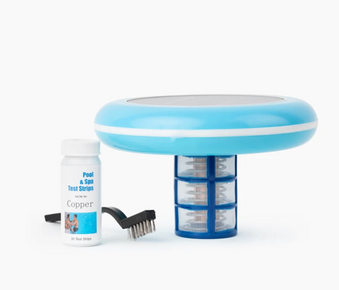
For comprehensive pool care that prevents both staining and algae growth while reducing chemical usage, consider adding a Solar Pool Ionizer which releases controlled amounts of copper and silver ions to naturally prevent algae without the risk of staining associated with copper based algaecides, while reducing chlorine needs by up to 85% for clearer, healthier pool water.