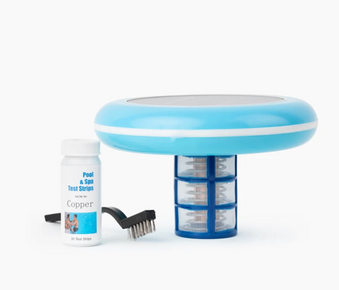
TL;DR: Pool budget strategy has been transformed by the adoption of solar pool ionizers, shifting the financial model from unpredictable operating expenses to planned capital investments. Traditional pools consume thousands of dollars annually in chemicals, energy, and emergency repairs costs that fluctuate wildly and resist accurate forecasting. Solar ionization replaces this uncertainty with predictable, manageable expenses: a modest upfront investment, minimal annual chemical costs, reduced energy bills, and scheduled component replacement every 3 to 5 years. This guide explores how solar pool ionizers impact every aspect of pool budgeting, from initial purchase decisions to 10-year financial planning.
SEO Summary: 2026 guide to solar pool ionizer impact on pool budget strategy: shifting from unpredictable operating costs to planned investments, chemical savings, energy reduction, equipment longevity, and 10-year financial planning.
Table of Contents
The Paradigm Shift in Pool Budgeting
Pool ownership has historically been characterized by financial unpredictability. The costs of maintaining a traditional pool fluctuate wildly based on chemical prices, energy rates, equipment failures, and unexpected problems. This uncertainty makes accurate budgeting difficult and creates financial stress for pool owners.
Solar pool ionizers fundamentally change this dynamic. By replacing reactive chemical management with stable, predictable mineral sanitation, they transform pool budgeting from a series of surprises into a planned, manageable financial strategy.
- Traditional pool budgets are dominated by variable operating expenses. Chemical costs fluctuate with market prices and seasonal demand. Energy bills vary with pump runtime and equipment efficiency. Repair costs appear without warning. This variability makes accurate forecasting nearly impossible.
- Ionized pool budgets shift toward planned capital investments. The initial system purchase represents the largest expense, followed by predictable, infrequent component replacements. Operating costs become minimal and stable, allowing accurate multi-year planning.
- Chemical price volatility is eliminated. Chlorine prices can spike due to supply disruptions, transportation costs, or seasonal demand. Ionized pools use 80 to 90 percent fewer chemicals, insulating owners from these fluctuations.
- Energy cost predictability improves. With stable pump schedules and reduced runtime, energy consumption becomes consistent and forecastable. Variable-speed pumps add further predictability by operating at known speeds for known durations.
- Emergency expenses virtually disappear. The stable chemistry and predictive maintenance of ionized pools mean that unexpected failures requiring immediate expenditure are rare. Budgets can focus on planned maintenance rather than emergency repairs.
The paradigm shift in pool budgeting is one of the most compelling financial benefits of solar ionization. The movement toward low-chemical pools, documented in our analysis of low-chemical pool trends, is driven in part by this desire for financial predictability.
Initial Investment Analysis
The initial investment in a solar pool ionizer system is the largest single expense in the new budget model. Understanding this investment in context is essential for accurate financial planning.
- System costs range from $900 to $1,500 for complete residential systems, including controller, ionizer chamber, solar panel, and installation hardware. This compares favorably to other pool investments such as variable-speed pumps ($800 to $1,500), salt chlorine generators ($1,200 to $2,000), or pool heaters ($2,000 to $5,000).
- DIY installation is feasible for most homeowners, eliminating labor costs. Basic plumbing skills and the ability to mount a solar panel are the primary requirements. Professional installation, where desired, typically adds $300 to $600.
- Comparison to traditional startup costs provides context. A new chlorinated pool requires chemical startup packages, test kits, and often a chlorine feeder, totaling $300 to $500. While less than an ionizer, these are ongoing rather than one-time costs.
- Financing options make the investment accessible. Many pool equipment suppliers offer financing, and some homeowners use home equity lines or 0 percent promotional credit cards. The rapid payback period (typically 1 to 2 years) makes financing attractive.
- Tax considerations may apply in some jurisdictions. Energy-efficient home improvements sometimes qualify for credits or deductions. While ionizers themselves may not qualify, associated equipment like variable-speed pumps often do.
- Bundled purchases with other upgrades can reduce overall costs. Combining an ionizer with a variable-speed pump purchase may qualify for volume discounts or reduced installation fees.
The initial investment should be viewed as a capital improvement that delivers returns for decades, not as an operating expense. The principles of residential pool investment, including detailed financial analysis, are explored in our investment strategies resource, which helps owners evaluate the financial case.
Chemical Budget Transformation
The most immediate and dramatic impact on pool budgeting comes from the transformation of chemical expenses. Solar ionization reduces chemical costs by 80 to 90 percent, converting a major variable expense into a minimal, predictable cost.
- Traditional chemical budgets range from $600 to $900 annually for a typical residential pool. This includes chlorine, algaecides, clarifiers, shock treatments, pH adjusters, and cyanuric acid. These costs vary with pool size, usage, and local chemical prices.
- Ionized pool chemical budgets range from $80 to $150 annually. This includes occasional pH adjusters, non-chlorine shock for oxidation, and possibly sequestering agents for metal control. The reduction is immediate and sustained.
- Chlorine elimination of 80 to 90 percent removes the largest chemical expense. Where traditional pools consume 200 to 300 pounds of chlorine products annually, ionized pools use 20 to 40 pounds primarily for backup or occasional shocking.
- Algaecide elimination saves $100 to $200 annually. Copper ions provide continuous algae prevention, making separate algaecide products unnecessary.
- Clarifier elimination saves $50 to $100 annually. Ionic flocculation naturally improves water clarity, eliminating the need for clarifier products.
- pH adjuster reduction of 50 to 70 percent saves additional money. The stable chemistry of ionized water requires far less acid or base, and adjustments use smaller quantities.
- Shock treatment reduction from weekly to occasional saves $100 to $150 annually. Non-chlorine shock used after heavy use replaces weekly chlorine shocking.
- Cyanuric acid elimination removes a recurring cost. CYA, required for chlorine pools, must be periodically replenished and eventually diluted through draining.
Chemical budget transformation delivers $500 to $700 in annual savings, which alone often pays for the ionizer system within 2 years. The principles of simpler pool chemistry that enable these savings are detailed in our guide to simpler pool chemistry with solar pool ionizer, demonstrating how few parameters actually require attention.
Energy Budget Reduction
Energy costs represent the second major operating expense transformed by solar ionization. Reduced pump runtime, lower-speed operation, and eliminated sanitation energy combine to deliver substantial savings.
- Traditional energy budgets for pool pumps range from $300 to $600 annually, depending on local electricity rates and pump runtime. A typical single-speed pump running 10 hours daily consumes 3,000 to 4,000 kilowatt-hours annually.
- Sanitation energy for salt chlorine generators adds $150 to $300 annually. These systems draw 200 to 500 watts during operation, consuming 500 to 1,500 kilowatt-hours per year.
- Ionized pool energy budgets range from $100 to $200 annually for pump operation. Sanitation energy is zero, provided by the solar panel. This represents a 60 to 75 percent reduction in total energy costs.
- Pump runtime reduction of 40 to 60 percent directly lowers energy consumption. Where a traditional pool runs 10 hours, an ionized pool often achieves perfect clarity in 4 to 6 hours.
- Lower speed operation with variable-speed pumps multiplies these savings. Reducing pump speed by 50 percent cuts power consumption by nearly 90 percent, according to the affinity laws. A pump operating at 1500 RPM consumes far less than one at 3450 RPM.
- Solar-synchronous operation further reduces grid consumption. Scheduling pump operation during peak solar hours allows solar panels to offset energy use. With battery storage, evening operation can also be solar-powered.
- Heating energy savings of 10 to 20 percent result from scale prevention and perceived warmth. Scale-free heat exchangers maintain peak efficiency, and the silky feel of ionized water allows lower thermostat settings.
Energy budget reduction delivers $300 to $500 in annual savings, compounding with chemical savings to create rapid payback. The principles of solar-powered pool care are explored in our guide to solar-powered operation, which provides detailed analysis of achievable energy savings.
Maintenance and Repair Budget
Maintenance and repair costs are often the most unpredictable element of pool budgeting. Solar ionization transforms this category from reactive expenses to planned investments.
- Traditional maintenance budgets include filter cleaning supplies, test kit replacements, and miscellaneous chemicals. These typically run $100 to $200 annually but can spike unexpectedly when equipment fails.
- Repair budgets are highly variable. Pump repairs ($200 to $500), heater repairs ($300 to $800), and other unexpected failures can occur at any time. The corrosive environment of chlorinated pools accelerates component degradation.
- Ionized pool maintenance budgets are minimal and predictable. Filter cleaning supplies, occasional test strip refills, and maybe a bottle of non-chlorine shock constitute the regular expenses, totaling $50 to $100 annually.
- Repair costs drop dramatically in the non-corrosive environment. Pumps, heaters, and other equipment last 30 to 50 percent longer and experience fewer failures. When repairs are needed, they are often planned rather than emergency responses.
- Predictive maintenance capabilities of modern ionizer systems further reduce uncertainty. Alerts for electrode replacement, filter cleaning, and potential issues allow budgeting for these expenses well in advance.
- Extended equipment warranties may be available for ionized pools. Some manufacturers offer longer warranties when their equipment is used in non-corrosive environments, providing additional financial protection.
Maintenance and repair budget transformation delivers peace of mind as much as financial savings. The predictable maintenance enabled by solar ionization is detailed in our article to predictable pool maintenance, which provides systematic approaches to managing ongoing costs.
Equipment Replacement Planning
Equipment replacement is the largest long-term expense in pool ownership. Solar ionization transforms this category by extending equipment life and making replacement timing predictable.
- Traditional equipment replacement schedules are unpredictable and often accelerated by chemical damage. Heaters may fail in 5 to 8 years, pumps in 8 to 10 years, and filters in 7 to 10 years. Replacement costs add up quickly: heater $1,500 to $3,000, pump $600 to $1,200, filter $300 to $800.
- Ionized pool equipment life extends significantly. Heaters achieve 12 to 15 years, pumps 12 to 15 years, filters 12 to 15 years. This 30 to 50 percent extension reduces annualized replacement costs proportionally.
- Electrode replacement is the only regular component replacement in the ionizer system itself. Electrodes cost $80 to $150 and need replacement every 3 to 5 years. This predictable expense can be budgeted years in advance.
- Controller upgrades every 5 to 8 years may be desired to access new features. These cost $300 to $800 and can be planned as technology investments rather than emergency replacements.
- Solar panel replacement after 20 to 25 years is rarely needed within typical ownership periods but can be budgeted for long-term owners. Quality panels carry 25-year warranties.
- Sinking fund planning becomes practical with predictable replacement schedules. Setting aside $100 to $200 annually covers electrode replacements, controller upgrades, and eventual major equipment replacement.
Equipment replacement planning transforms what was once a financial surprise into a manageable, budgeted expense. The long-term planning strategies enabled by this predictability are explored in our long-term planning resource, which provides comprehensive guidance for 5, 10, and 20-year horizons.
Emergency Fund Elimination
One of the most significant psychological benefits of solar ionization is the elimination of the need for an emergency pool fund. The reactive nature of traditional pools requires setting aside money for unexpected problems that inevitably arise.
- Traditional pool owners maintain mental or actual emergency funds for algae outbreaks, equipment failures, and chemical emergencies. These funds may range from $500 to $2,000, tied up and unavailable for other purposes.
- Algae outbreaks, the most common emergency, can cost $100 to $300 in chemicals and additional pump runtime. More importantly, they create stress and require immediate attention regardless of budget constraints.
- Equipment failures often occur at the worst times mid-summer when the pool is in constant use. Emergency repair or replacement costs can run $500 to $2,000 with no time for comparison shopping.
- Chemical emergencies such as chlorine lock, metal cloudiness, or pH crashes require immediate corrective purchases. These unplanned expenses disrupt household budgeting.
- Ionized pools experience these emergencies rarely if ever. The stable chemistry prevents sudden water quality deterioration. Predictive maintenance alerts provide weeks of notice before any component needs attention.
- The emergency fund can be repurposed or eliminated. Money previously reserved for pool crises can be invested, used for other improvements, or simply kept as general savings.
Emergency fund elimination is both a financial and psychological benefit. The peace of mind that comes from knowing the pool will not suddenly require hundreds or thousands of dollars is valuable in itself. The transformation of backyard pools into reliable, predictable systems is documented in our reinventing backyard pools article, which explores how this reliability changes the ownership experience.
10-Year Financial Planning
The cumulative impact of solar ionization on pool budgeting becomes most apparent over a 10-year planning horizon. The shift from unpredictable operating expenses to planned capital investments delivers substantial long-term savings.
- 10-year traditional pool costs: A typical residential pool over 10 years will spend:
- Chemicals: $6,000 to $9,000
- Energy: $3,000 to $6,000
- Equipment replacement: $3,000 to $6,000
- Emergency repairs: $1,000 to $3,000
- Total: $13,000 to $24,000
- 10-year ionized pool costs: The same pool with solar ionization will spend:
- Initial system: $900 to $1,500
- Chemicals: $800 to $1,500
- Energy: $1,000 to $2,000
- Electrode replacements (2 to 3): $200 to $450
- Controller upgrade (optional): $300 to $800
- Equipment replacement (reduced): $1,500 to $3,000
- Total: $4,700 to $9,250
- 10-year savings range from $8,300 to $14,750, a 60 to 65 percent reduction in total cost of ownership.
- Annualized savings of $800 to $1,500 per year compound over time. Invested at modest returns, these savings grow further.
- Inflation protection is inherent in the ionized model. As chemical and energy prices rise over time, the 80 to 90 percent reduction in consumption provides increasing dollar savings.
- Property value enhancement may add additional returns. A modern, low-maintenance, eco-friendly pool is an attractive feature for future buyers, potentially increasing resale value.
10-year financial planning demonstrates the compelling economics of solar ionization. The investment strategies that maximize these returns are explored in our investment strategies resource, which provides detailed financial analysis and planning tools.
Return on Investment Analysis
Return on investment (ROI) analysis provides a clear picture of the financial case for solar ionization. The numbers consistently show rapid payback and exceptional long-term returns.
- Simple payback period calculation:
- Initial investment: $1,200 (typical installed system)
- Annual savings: $1,100 (chemicals $600, energy $400, maintenance $100)
- Payback period: 13 months
- Five-year ROI:
- Total savings over 5 years: $5,500
- Electrode replacement cost (1): $120
- Net savings: $5,380
- ROI: 448 percent (($5,380 - $1,200) / $1,200)
- Ten-year ROI:
- Total savings over 10 years: $11,000
- Electrode replacements (2): $240
- Controller upgrade (optional): $500
- Net savings: $10,260
- ROI: 855 percent
- Internal rate of return (IRR) calculations, which account for the timing of cash flows, typically show IRRs of 50 to 100 percent, far exceeding most investments.
- Risk-adjusted returns are exceptional because the savings are guaranteed. Unlike stock market investments, chemical and energy savings are contractual you will not buy what you do not purchase.
- Tax-free nature of savings makes the returns even more valuable. Investment gains may be taxable; avoided expenses are not.
Return on investment analysis confirms that solar ionization is not just an environmental choice but a superior financial decision. The rise of solar pool ionizers, documented in our article on rise of solar pool ionizer in modern pool , is driven in large part by these compelling economics.
Conclusion & Key Takeaways
Solar pool ionizers fundamentally impact pool budget strategy in 2026, transforming the financial model from unpredictable operating expenses to planned capital investments. The initial investment of $900 to $1,500 delivers annual savings of $1,000 to $1,500, paying for itself in 12 to 18 months and delivering exceptional returns over the following decades.
Chemical budgets drop from $600 to $900 annually to $80 to $150. Energy budgets fall from $500 to $800 to $100 to $200. Maintenance and repair costs become minimal and predictable. Equipment replacement extends from 5 to 8 years to 12 to 15 years. Emergency funds can be eliminated entirely.
Over a 10-year horizon, total cost of ownership drops by 60 to 65 percent, saving $8,000 to $15,000 compared to traditional pools. These savings compound over longer ownership periods, and they increase as chemical and energy prices rise.
The financial case for solar ionization is compelling, but it is only part of the story. The same technology that delivers these economic benefits also provides superior water quality, a better swimming experience, and reduced environmental impact. Solar pool ionizers are not just a smarter financial choice they are a better choice in every dimension.
Key Takeaways
- Pool budget strategy shifts from unpredictable operating expenses to planned capital investments. The reactive nature of traditional pools creates financial uncertainty that ionized pools eliminate.
- Initial investment of $900 to $1,500 delivers rapid payback. With annual savings of $1,000 to $1,500, payback occurs in 12 to 18 months. Our investment strategies resource provides detailed analysis.
- Chemical budgets drop by 80 to 90 percent. From $600 to $900 annually to $80 to $150, this transformation alone often justifies the investment.
- Energy budgets fall by 60 to 75 percent. Reduced pump runtime, lower-speed operation, and eliminated sanitation energy deliver $300 to $500 in annual savings.
- Maintenance and repair costs become minimal and predictable. The non-corrosive environment reduces failures, and predictive maintenance enables planning.
- Equipment replacement extends significantly. Heaters last 12 to 15 years instead of 5 to 8. Pumps last 12 to 15 years instead of 8 to 10. Our long-term planning resource provides replacement schedules.
- Emergency funds can be eliminated. The stable chemistry and predictive capabilities of ionized pools mean that unexpected expenses are rare.
- 10-year savings total $8,000 to $15,000. Total cost of ownership drops by 60 to 65 percent compared to traditional pools.
- Return on investment is exceptional. Five-year ROI exceeds 400 percent. Ten-year ROI exceeds 800 percent. These returns are guaranteed, not speculative.
- The financial benefits compound with other advantages. Superior water quality, better swimmer experience, and reduced environmental impact all accompany the economic gains. Our guide on low-chemical pool trends with solar pool ionizer demonstrates how these factors together are driving adoption.
Every pool owner deserves the financial predictability and long-term savings that solar ionization delivers. The technology is proven, the economics are compelling, and the path to a more efficient pool budget is clear.