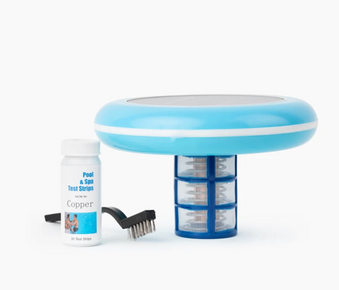
TL;DR: Simpler pool chemistry is the most transformative benefit that solar pool ionizers bring to pool ownership. Traditional pools require managing multiple interacting chemical parameters chlorine, pH, alkalinity, calcium hardness, cyanuric acid, and various algaecides and clarifiers each with its own testing schedule, adjustment protocols, and unpredictable behaviors. Solar ionization reduces this complexity to three primary parameters pH, copper concentration, and alkalinity with pH being the only one requiring regular attention. This 2026 guide explains how solar ionizers simplify water chemistry, eliminate the chemical juggling act of traditional pools, and create a maintenance routine that anyone can master.
SEO Summary: 2026 guide to simpler pool chemistry with solar pool ionizers: reduced chemical parameters, stable pH, predictable copper levels, and elimination of cyanuric acid and complex chemical interactions.
Table of Contents
- The Unnecessary Complexity of Traditional Pool Chemistry
- How Solar Ionizers Simplify Water Chemistry
- pH: The One Parameter That Still Matters
- Copper Management: Simple and Predictable
- Alkalinity: The Silent Partner
- Eliminated Parameters: What You No Longer Test
- Testing Simplified: From Daily to Weekly
- Adjustment Simplified: From Cups to Drops
- Record Keeping: Tracking What Actually Matters
- Conclusion & Key Takeaways
The Unnecessary Complexity of Traditional Pool Chemistry
Traditional pool chemistry is a study in unnecessary complexity. What should be a simple task maintaining clean, safe water becomes a juggling act of multiple chemical parameters, each with its own testing schedule, adjustment protocols, and unpredictable interactions.
The Chemical Cast of Characters:
- Free chlorine: The primary sanitizer, but unstable and constantly changing. It dissipates in sunlight, reacts with organic matter, and fluctuates with bather load. Testing is required daily, sometimes more often.
- Combined chlorine (chloramines): The byproduct of chlorine reacting with contaminants. High levels cause eye irritation and the characteristic pool smell. Requires periodic shocking to eliminate.
- pH: Affects chlorine effectiveness, swimmer comfort, and equipment corrosion. Constantly drifts due to chlorine additions, aeration, and rain.
- Total alkalinity: Buffers pH but must be maintained in a narrow range. Too low allows pH swings, too high causes pH drift.
- Calcium hardness: Low levels cause water to become aggressive and etch surfaces. High levels cause scale formation on equipment and surfaces.
- Cyanuric acid (stabilizer): Protects chlorine from UV degradation but accumulates over time. High levels reduce chlorine effectiveness, requiring partial draining.
- Algaecides: Added preventively or reactively to control algae, introducing additional chemicals to manage.
- Clarifiers and enzymes: Optional additives that further complicate the chemical picture.
These parameters do not operate independently. They interact in complex ways that challenge even experienced pool professionals. Chlorine affects pH. pH affects chlorine effectiveness. Alkalinity affects pH stability. Cyanuric acid affects chlorine activity. Calcium affects scaling potential, which is influenced by pH. The interconnections create a system where adjusting one parameter often requires adjusting others, leading to a never-ending cycle of testing and correction.
For pools struggling with this chemical complexity, our guide to chemistry management for longer equipment life provides strategies for transitioning to simpler alternatives.
How Solar Ionizers Simplify Water Chemistry
Solar pool ionizers achieve dramatic chemical simplification by replacing the reactive, unstable chemistry of chlorine with the persistent, stable chemistry of copper and silver ions. The simplification operates on multiple levels.
Elimination of the Primary Sanitizer Cycle:
Chlorine requires constant replenishment because it is consumed by sunlight, heat, and organic matter. Copper ions are not consumed they remain active indefinitely. This single difference eliminates the entire cycle of daily chlorine testing, weekly shocking, and emergency chlorine additions. The primary sanitizer simply stays where it is put.
Elimination of Supporting Chemicals:
With chlorine gone, the chemicals required to support chlorine also disappear. Cyanuric acid, added to protect chlorine from UV degradation, is unnecessary because copper does not degrade in sunlight. Algaecides become redundant because copper itself is an effective algaecide. Clarifiers are largely unnecessary because ionic flocculation naturally improves clarity. Shock treatments become occasional rather than weekly.
Reduction of Interacting Parameters:
Traditional chemistry involves multiple interacting parameters that affect each other in complex ways. Ionized chemistry reduces this to three primary parameters that operate largely independently:
- pH: Affects copper solubility and swimmer comfort, but does not interact with other parameters in complex ways.
- Copper concentration: The primary sanitation parameter, independent of other factors except pH.
- Alkalinity: Buffers pH but has no direct effect on copper efficacy.
Stability Over Time:
Perhaps most importantly, ionized chemistry is stable over time. Chlorine levels can drop from ideal to inadequate in hours. Copper levels change slowly over days and weeks. This stability means that when you test and find parameters in range, you can trust that they will remain in range for days or weeks, not hours.
Predictability of Behavior:
Copper consumption follows predictable patterns based on temperature and filtration. Once you learn your pool's patterns, you can anticipate when adjustments will be needed rather than discovering them through testing. pH drifts at a predictable rate that becomes known after a few weeks of observation.
For a comprehensive overview of how solar ionization transforms the entire ownership experience, our article on smarter pool ownership explores the full range of benefits enabled by simpler chemistry.
pH: The One Parameter That Still Matters
In ionized pools, pH becomes the primary focus of chemical management. Fortunately, pH in ionized pools is far more stable and predictable than in chlorinated pools.
Why pH Still Matters:
pH affects two aspects of ionized pool operation. First, copper solubility decreases at high pH. Above 7.8, copper begins to precipitate out of solution, reducing sanitation effectiveness and potentially causing staining. Second, swimmer comfort is optimal in the 7.4 to 7.6 range. pH outside this range can cause eye irritation even without chlorine.
pH Stability in Ionized Pools:
Without chlorine additions constantly pushing pH in different directions, without continuous acid demand from salt generators, pH in ionized pools drifts slowly and predictably. Typical drift rates range from 0.01 to 0.03 units per day in pools with minimal aeration, to 0.03 to 0.06 units per day in pools with water features. This compares to 0.2 to 0.4 units per week in chlorinated pools.
Establishing Your Pool's pH Pattern:
To simplify pH management, spend a few weeks establishing your pool's characteristic pH behavior. Record pH at the same time each day for two weeks without adjusting. Note the daily change and look for patterns related to aeration, rainfall, or usage. Once you know your pool's drift rate, you can predict when pH will reach adjustment thresholds.
Simplified pH Adjustment:
With known drift rates, pH adjustment becomes scheduled rather than reactive. If your pool drifts 0.02 units per day and you set pH to 7.5, you know it will reach 7.6 in five days. You can schedule adjustment for that day, confident that pH will remain within range until then. The amount of acid or base needed becomes predictable as well, typically measured in fluid ounces rather than cups.
Automated pH Control:
For ultimate simplification, automated pH controllers eliminate even scheduled adjustments. These devices continuously monitor pH and inject acid or carbon dioxide as needed to maintain setpoint. With automation, pH becomes completely hands-off. Our information on modern pool system integration provides specifications for adding automated pH control.
Copper Management: Simple and Predictable
Copper concentration is the primary sanitation parameter in ionized pools, but its management is far simpler than chlorine management. Copper is not consumed by sunlight or organic matter, so it does not require daily replenishment.
Target Copper Range:
The target copper concentration for residential pools is 0.2 to 0.4 parts per million. This narrow range provides effective algae and bacteria control while minimizing staining risk. Concentrations below 0.2 ppm may allow algae to establish; concentrations above 0.5 ppm increase staining potential without improving sanitation.
Copper Testing Simplified:
Copper testing is required weekly, not daily. Test strips designed specifically for copper provide adequate accuracy for routine monitoring, with results readable in 30 to 60 seconds. Digital copper meters offer laboratory accuracy for those who prefer quantitative results. Unlike chlorine testing, which must be interpreted in context of pH, temperature, and CYA, copper testing is straightforward a single number that tells you whether you are in range.
Understanding Copper Consumption:
Copper is slowly removed from pool water through two mechanisms: filtration of particles to which copper has attached, and precipitation when concentrations exceed solubility limits. Both mechanisms follow predictable patterns based on measurable factors. Filtration removal correlates with pump runtime and filter efficiency. Precipitation correlates with pH and calcium levels. Once these relationships are understood, copper consumption becomes highly predictable.
Adjusting Copper Output:
When weekly testing shows copper below target, increase ionizer output slightly. When copper exceeds target, decrease output. Adjustments are typically small 5 to 10 percent increments and are needed only occasionally. Most ionizer owners find that once they establish their pool's optimal setting, they adjust output two to four times per year in response to seasonal changes.
Temperature Compensation:
Modern ionizer controllers with temperature compensation automatically adjust output based on water temperature. This feature simplifies copper management further by matching output to biological demand. When water warms in summer, output increases automatically. When water cools in fall, output decreases. With temperature compensation, manual adjustments become even less frequent.
For pools experiencing copper testing challenges, our resource on troubleshooting copper test strips provides solutions for common issues.
Alkalinity: The Silent Partner
Total alkalinity plays a supporting role in ionized pool chemistry, buffering pH against rapid swings. Its management is straightforward and infrequent.
Alkalinity's Function:
Alkalinity acts as a pH buffer, resisting changes that would otherwise occur from acid rain, aeration, or chemical additions. In ionized pools, with fewer chemicals added and more stable chemistry, alkalinity's buffering function is less stressed than in chlorinated pools.
Target Alkalinity Range:
The target alkalinity range for ionized pools is 80 to 120 parts per million. Some experienced ionizer owners prefer the lower end of this range, 70 to 90 ppm, for optimal pH stability. Alkalinity below 60 ppm allows pH to swing excessively. Alkalinity above 120 ppm can cause pH to drift upward.
Testing Frequency:
Alkalinity testing is required monthly, not weekly. Because few chemicals are added to ionized pools, alkalinity changes slowly. Monthly testing is sufficient to verify that alkalinity remains in range and to detect any developing trends.
Adjusting Alkalinity:
When alkalinity falls below 80 ppm, raise it using sodium bicarbonate (baking soda). The required amount is easily calculated using online calculators or simple formulas approximately 1.5 pounds per 10,000 gallons raises alkalinity by 10 ppm.
When alkalinity exceeds 120 ppm, lower it using muriatic acid combined with aeration. This process is slower than raising alkalinity and may require multiple adjustments over several days. Fortunately, high alkalinity is rare in well-maintained ionized pools.
Alkalinity and pH Relationship:
The relationship between alkalinity and pH is simpler in ionized pools. Without chlorine additions affecting pH, alkalinity's buffering function is more straightforward. When alkalinity is in range, pH tends to remain stable. When pH begins to drift consistently, alkalinity is often the first place to check.
Eliminated Parameters: What You No Longer Test
The most dramatic simplification from solar ionization comes from the parameters you no longer need to test, track, or adjust. The list is substantial.
Free Chlorine:
Eliminated entirely. Without chlorine addition, there is no chlorine to test. The primary sanitizer parameter becomes copper concentration, which is tested weekly rather than daily.
Combined Chlorine (Chloramines):
Eliminated entirely. Without chlorine, chloramines cannot form. The eye-burning, odorous byproducts of chlorine sanitation simply do not exist.
Cyanuric Acid (Stabilizer):
Eliminated entirely. Copper does not require UV protection, so cyanuric acid is unnecessary. Any CYA present from previous chlorine use gradually dilutes over time and eventually reaches negligible levels. The periodic draining required to reset CYA in chlorinated pools becomes a thing of the past.
Calcium Hardness (mostly):
While calcium hardness still matters for scale prevention, it becomes a parameter you monitor annually rather than manage frequently. Without the calcium inputs from certain chlorine products and without the pH swings that cause precipitation, calcium levels remain stable for years. Annual testing is sufficient to verify that calcium remains in the 200 to 300 ppm range.
Algaecides:
Eliminated entirely. Copper itself is an effective algaecide, so separate algaecide products are unnecessary. This eliminates an entire category of chemical testing and adjustment.
Clarifiers and Enzymes:
Largely eliminated. Ionic flocculation naturally improves water clarity, reducing or eliminating the need for clarifiers. Enzyme treatments may still be beneficial for heavy organic loads, but they become optional enhancements rather than routine requirements.
Shock Treatments:
Reduced from weekly to occasional. Non-chlorine shock may be used after heavy bather loads or rain events, but the weekly shocking required by chlorinated pools is eliminated.
The elimination of these parameters transforms pool chemistry from a complex juggling act into a simple, manageable routine. Our article on making family pools safer explores how this simplification benefits families with young children.
Testing Simplified: From Daily to Weekly
The simplification of pool chemistry directly translates to simplified testing routines. What was once a daily or even twice-daily task becomes a weekly check that takes minutes.
Traditional Testing Burden:
Chlorinated pools require daily testing of free chlorine and pH. Weekly testing must include alkalinity, calcium hardness, and cyanuric acid. Shock treatments require before-and-after testing. After heavy use or rain, additional testing is needed. The cumulative time and mental energy required is substantial.
Ionized Pool Testing Schedule:
- Daily (30 seconds): Visual clarity check and pH quick test (optional after initial stabilization). Many ionizer owners find that daily pH testing is unnecessary after they learn their pool's drift pattern.
- Weekly (5 minutes): Copper concentration test and full pH test. This single weekly check verifies that both primary parameters are in range.
- Monthly (10 minutes): Alkalinity test and visual electrode inspection. Monthly testing confirms that the pH buffer is adequate and that the ionizer is functioning properly.
- Annually (15 minutes): Calcium hardness test and comprehensive water analysis. Annual testing verifies long-term stability and predicts when future adjustments may be needed.
Testing Accuracy Simplified:
Copper testing is more straightforward than chlorine testing. There is no equivalent of the chlorine-pH-CYA triangle that requires interpreting results in context. A copper reading of 0.3 ppm means the same thing regardless of pH, temperature, or time of day. This simplicity reduces testing errors and increases confidence in results.
Test Kit Simplification:
An ionized pool owner's test kit is simpler than a chlorinated pool owner's kit. Copper test strips or a digital copper meter, pH test kit, alkalinity test kit, and perhaps a calcium hardness kit for annual use. No DPD powder for chlorine testing, no cyanuric acid test, no complex drop-count tests for multiple parameters.
Digital Testing Options:
For maximum simplification, digital testers eliminate the subjectivity of color matching. Digital copper meters provide laboratory accuracy with a simple probe dip. Digital pH meters eliminate the guesswork of matching colors. These tools reduce testing time and increase confidence in results.
Adjustment Simplified: From Cups to Drops
When adjustments are needed in ionized pools, they are smaller, less frequent, and simpler to execute than in chlorinated pools.
Copper Adjustment:
Adjusting copper levels is as simple as turning a dial or pressing a button on the ionizer controller. Increase output slightly when weekly testing shows copper trending low. Decrease output when copper consistently exceeds target. No measuring, no mixing, no pouring of chemicals. The ionizer does the work.
pH Adjustment:
pH adjustments in ionized pools are measured in fluid ounces rather than cups. Because pH drifts slowly, only small corrections are needed to bring it back to target. A typical adjustment might be 4 to 8 fluid ounces of muriatic acid or soda ash, compared to 16 to 32 ounces in a chlorinated pool.
Alkalinity Adjustment:
Alkalinity adjustments are infrequent, typically needed only once or twice per year. When required, the calculation is simple and the product sodium bicarbonate is inexpensive and safe to handle.
Elimination of Shock Adjustments:
Weekly shocking, with its precise timing and post-shock testing requirements, is eliminated entirely. Occasional non-chlorine shock after heavy use is optional and requires no follow-up testing beyond normal weekly checks.
No Emergency Adjustments:
Perhaps the most valuable simplification is the elimination of emergency adjustments. In chlorinated pools, a forgotten test or unexpected bather load can lead to plummeting chlorine and emergency chemical additions. In ionized pools, copper levels decline slowly over days and weeks. An overlooked test does not create a crisis. The pool gives you time to respond.
Adjustment Documentation:
When adjustments are needed, document them in a simple log. Record date, parameter adjusted, amount added, and result. Over time, this log reveals patterns that allow you to anticipate future adjustments with remarkable accuracy.
Record Keeping: Tracking What Actually Matters
Simpler chemistry enables simpler record keeping. Instead of tracking multiple parameters with complex interactions, you track a few key indicators that tell the complete story of your pool's health.
What to Track:
- Copper concentration: Weekly reading. The primary sanitation indicator.
- pH: Weekly reading. The primary comfort and stability indicator.
- Alkalinity: Monthly reading. The buffer status indicator.
- Ionizer output setting: Record when changed. Helps correlate output with copper levels.
- Water temperature: Optional but useful for understanding seasonal patterns.
- Notable events: Heavy rain, parties, equipment maintenance. Helps explain any unexpected readings.
Simple Tracking Methods:
A basic spreadsheet or even a notebook is sufficient for tracking. Create columns for date, copper reading, pH, alkalinity, temperature, and notes. Enter data weekly. After a few months, patterns will emerge that make your pool's behavior predictable.
What the Data Tells You:
Over time, your records will reveal your pool's characteristic patterns. You will learn how much copper is consumed per degree of temperature increase. You will know how many days after a party copper levels need checking. You will predict when alkalinity will drift out of range. This knowledge transforms pool maintenance from reactive to proactive.
Digital Record Keeping:
Smart controllers automatically log many of these parameters, eliminating manual record keeping. Copper output, pH readings, temperature, and pump runtime are stored and viewable through smartphone apps. Some systems provide trend analysis and predictive alerts based on historical data.
Using Records for Troubleshooting:
When something unexpected occurs, your records provide the context needed for troubleshooting. A sudden drop in copper becomes understandable when you see that water temperature spiked and bather load was heavy. A pH excursion makes sense when you note the recent heavy rain. Records turn mystery into understanding.
Conclusion & Key Takeaways
Simpler pool chemistry is not just a convenience it is a fundamental improvement in the pool ownership experience. The complexity of traditional pool chemistry with its multiple interacting parameters, daily testing requirements, and unpredictable behaviors creates stress and consumes time that could be spent enjoying the pool.
Solar pool ionizers deliver simpler chemistry by replacing the reactive, unstable chemistry of chlorine with the persistent, stable chemistry of copper and silver ions. The number of parameters you must manage drops from eight or more to three. Testing frequency drops from daily to weekly. Adjustment quantities drop from cups to ounces. Emergency responses drop from common to rare.
The result is a pool that requires less time, less mental energy, and less chemical handling. A pool that is more forgiving of occasional neglect. A pool that anyone can maintain, regardless of their chemistry background.
Simpler chemistry does not mean compromised water quality. Ionized pools achieve clarity, sanitation, and swimmer comfort that chlorinated pools cannot match. The simplification comes not from cutting corners but from using fundamentally better technology.
Key Takeaways
- Traditional pool chemistry is unnecessarily complex: Multiple interacting parameters, daily testing, and unpredictable behaviors create stress and consume time. The chemical juggling act challenges even experienced pool owners. Our guide to chemistry management helps navigate this complexity.
- Ionizers simplify by eliminating most parameters: Copper and silver ions replace chlorine, cyanuric acid, algaecides, and clarifiers. The chemical cast drops from eight or more to three.
- pH becomes the primary focus: In ionized pools, pH is the one parameter that requires regular attention. Fortunately, pH in ionized pools is far more stable and predictable than in chlorinated pools.
- Copper management is straightforward: Weekly testing, occasional output adjustment, and predictable consumption patterns make copper management simple. Temperature compensation automates much of this. Our copper test troubleshooting resource ensures accurate readings.
- Alkalinity plays a supporting role: Monthly testing and infrequent adjustment maintain the pH buffer. Alkalinity's behavior is predictable and non-interactive.
- Eliminated parameters simplify everything: No chlorine testing, no chloramine management, no cyanuric acid tracking, no algaecide additions. These eliminations transform the maintenance routine. Our article on family-friendly pools highlights the safety benefits of this simplification.
- Testing becomes weekly rather than daily: A 5-minute weekly check replaces daily testing. Test kits are simpler, and results are easier to interpret.
- Adjustments become smaller and less frequent: Copper is adjusted at the controller. pH adjustments use ounces rather than cups. Alkalinity adjustments are needed once or twice per year.
- Record keeping reveals predictable patterns: Simple tracking of copper, pH, and alkalinity reveals your pool's characteristic behavior, enabling proactive rather than reactive maintenance.
- Simpler chemistry is better chemistry: The simplification does not compromise water quality. Ionized pools achieve superior clarity, sanitation, and swimmer comfort with far less effort. Our guidance on selecting a solar pool ionizer helps you choose the system that will deliver this simpler chemistry for your pool.
Every pool owner deserves the peace of mind that comes with simpler chemistry. The freedom from constant testing, the confidence that comes from predictable behavior, and the enjoyment of water that feels natural rather than chemical. Solar pool ionizers make this simpler chemistry accessible to everyone.