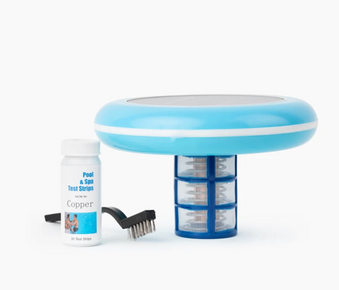
TL;DR: Solar-powered pool care represents the convergence of renewable energy technology and advanced water sanitation, offering pool owners a path to true energy independence. Solar pool ionizers harness the sun's energy to generate copper and silver ions that sanitize pool water continuously, eliminating grid electricity consumption for sanitation while dramatically reducing pump energy requirements. This 2026 guide explores how solar-powered pool care works, the technology behind modern ionizers, the energy savings achievable, and the path to operating your pool entirely on renewable energy.
SEO Summary: 2026 guide to solar-powered pool care with solar pool ionizers: renewable energy sanitation, energy independence, reduced grid consumption, and pathways to net-zero pool operation.
Table of Contents
- What Solar-Powered Pool Care Really Means
- Solar Sanitation: How Ionizers Harness the Sun
- Energy Independence: Reducing Grid Dependence
- Pump Synergy: Solar-Powered Circulation
- Solar Panel Technology for Pool Applications
- Battery Integration: 24-Hour Solar Operation
- Pathways to Net-Zero Energy Pools
- Solar Economics: ROI and Payback Analysis
- Climate Considerations for Solar Pool Care
- Conclusion & Key Takeaways
What Solar-Powered Pool Care Really Means
Solar-powered pool care is often misunderstood. Some assume it means using solar covers to retain heat. Others think of solar water heaters for warming the pool. While both are valuable, true solar-powered pool care goes much deeper it means powering the fundamental sanitation and circulation systems of your pool entirely with energy harvested from the sun.
- Solar sanitation: Using photovoltaic panels to generate the electricity needed for water sanitation, eliminating grid power consumption for this essential function.
- Solar-powered circulation: Operating pumps during daylight hours using solar energy, either directly from panels or from battery storage charged by the sun.
- Solar thermal integration: Supplementing with solar water heating to reduce or eliminate fossil fuel consumption for pool heating.
- Energy storage: Capturing excess solar energy in batteries for overnight or cloudy-day operation, enabling true energy independence.
Solar pool ionizers are the cornerstone of solar-powered pool care. Unlike salt chlorine generators that require continuous grid power, or ozone systems that demand electricity, ionizers are designed from the ground up to operate on solar energy. Their low power requirements, typically 5 to 20 watts, make them ideal for direct photovoltaic power.
For a comprehensive overview of how solar ionization transforms the entire pool ownership experience, our guide to smarter pool ownership explores the full range of benefits enabled by solar-powered care.
Solar Sanitation: How Ionizers Harness the Sun
The core of solar-powered pool care is the ionizer itself a device that uses solar energy to generate sanitizing ions directly from metal electrodes.
- The Basic Principle: A solar pool ionizer consists of three main components: a photovoltaic panel, a control unit, and an electrode chamber containing copper and silver electrodes. When sunlight strikes the solar panel, it generates direct current electricity. This low-voltage current flows to the electrodes, causing copper and silver ions to be released into the water passing through the chamber.
- Why Solar Works for Ionization: Ionization is inherently suited to solar power for several reasons. The power requirements are low typically 5 to 20 watts, well within the capacity of a modest solar panel. The process is continuous and does not require peak power for startup or operation. Most importantly, the demand for sanitation correlates with sunlight algae and bacteria are more active when the sun is shining, exactly when solar panels are producing.
- Solar Panel Sizing: A typical residential solar ionizer uses a 10 to 30 watt photovoltaic panel. This is sufficient to generate the low-voltage current needed for ion production in pools up to 40,000 gallons. The panel size is determined by the electrode surface area and the desired ion output rate. Larger pools or those in areas with less reliable sunshine may require larger panels or multiple panels.
- Direct vs. Battery-Buffered Operation: Basic solar ionizers operate directly from the solar panel, producing ions only when sunlight is available. This works well because ion production correlates with demand. More advanced systems incorporate capacitors or small batteries that store enough energy to maintain ion production through passing clouds or to provide overnight output at reduced levels.
- Controller Technology: Modern ionizer controllers optimize solar harvesting using Maximum Power Point Tracking (MPPT) technology. MPPT controllers continuously adjust the electrical load to extract maximum power from the solar panel under varying light conditions. This can increase energy harvest by 20 to 30 percent compared to simpler controllers, ensuring consistent ion production even on partly cloudy days.
For a deeper dive into the technology behind solar sanitation, our article on revolutionary pool care features explores MPPT and other advanced technologies.
Energy Independence: Reducing Grid Dependence
The ultimate goal of solar-powered pool care is energy independence freeing your pool from reliance on the electrical grid. Solar pool ionizers are the foundation of this independence, but achieving it requires a holistic approach.
- Sanitation Independence: A solar ionizer eliminates grid power consumption for sanitation entirely. Unlike salt chlorine generators that draw 200 to 500 watts continuously, or UV systems requiring 100 to 300 watts, ionizers operate solely on solar energy. This alone saves 500 to 1,500 kilowatt-hours annually for a typical pool.
- Circulation Independence: Pumps are the largest energy consumer in pool operation, typically accounting for 2,000 to 4,000 kilowatt-hours annually. Achieving circulation independence requires either operating pumps during daylight hours using solar power, or storing solar energy in batteries for overnight operation. Solar-synchronous pump scheduling the practice of running pumps when the sun is shining can eliminate most grid consumption for circulation. A variable-speed pump operating at low speed during daylight hours consumes 200 to 500 watts, which can be offset by a modest solar array.
- Heating Independence: Pool heating is the most energy-intensive aspect of pool operation, often exceeding pump energy by 2 to 5 times. Solar thermal collectors can provide much or all of a pool's heating needs, eliminating natural gas or heat pump consumption. When combined with solar ionization and solar-powered circulation, a pool can approach true energy independence.
- Measuring Energy Independence: Energy independence can be measured along several dimensions. Sanitation independence is easily achieved with an ionizer. Circulation independence requires proper pump scheduling and possibly battery storage. Heating independence requires solar thermal collectors. Many pool owners achieve 70 to 80 percent energy independence with ionizers and solar-synchronous pumping, then decide whether the additional investment for complete independence is justified.
- The Path to Independence: Most pool owners pursue energy independence in phases. Phase one install a solar ionizer and optimize pump scheduling. Phase two add a variable-speed pump if not already present. Phase three install solar panels dedicated to pump power. Phase four add battery storage for overnight operation. Phase five add solar thermal collectors for heating. This phased approach allows you to capture savings at each step while spreading investment over time.
For detailed guidance on reducing grid dependence, our resource on cutting pool energy costs provides specific strategies and calculations.
Pump Synergy: Solar-Powered Circulation
The synergy between solar ionizers and pool pumps is where the most dramatic energy savings occur. By coordinating pump operation with solar availability, you can achieve grid-free circulation for much of the swimming season.
- The Affinity Law Advantage: The affinity laws governing pump performance state that power consumption is proportional to the cube of speed. Reducing pump speed by 20 percent reduces power consumption by approximately 50 percent. Reducing speed by 50 percent reduces power consumption by nearly 90 percent. This makes variable-speed pumps ideal for solar-powered operation they can run for many hours at low speed while consuming minimal power.
- Solar-Synchronous Scheduling: Solar-synchronous scheduling means running your pump during daylight hours when solar panels are producing. A typical schedule might be 8:00 AM to 6:00 PM during summer, 10:00 AM to 4:00 PM during spring and fall. During these hours, the pump's power consumption can be offset by solar generation, either from the ionizer's panel (if sized appropriately) or from dedicated pump panels.
- Right-Sizing for Solar Operation: A pump sized for solar operation is smaller than one sized for conventional operation. Traditional pools oversize pumps to guarantee turnover regardless of filter loading. Solar-optimized pools right-size pumps based on actual flow requirements, then use the savings to fund solar panels. A properly sized variable-speed pump operating at low speed may consume only 150 to 300 watts, easily powered by a 400 to 600 watt solar array.
- Coordinated Control: Advanced systems coordinate ionizer and pump operation for maximum efficiency. The ionizer controller can communicate with the pump controller to request higher flow during peak production hours, ensuring optimal ion distribution. During cloudy periods, the pump can reduce speed to match available solar power, maintaining circulation without drawing grid power.
- Real-World Example: A typical 20,000-gallon pool with a variable-speed pump operating 12 hours at 200 watts consumes 2.4 kilowatt-hours daily. A 600-watt solar array can generate 3 to 4 kilowatt-hours daily, more than enough to power the pump. Combined with a solar ionizer that requires no grid power, this pool achieves 90 to 100 percent solar-powered operation during sunny months.
For specific guidance on pump selection and scheduling, our information on energy-efficient circulation systems provides detailed recommendations.
Solar Panel Technology for Pool Applications
Solar panels for pool applications differ in important ways from standard home solar installations. Understanding these differences helps in selecting the right panels for your solar-powered pool care system.
- Monocrystalline silicon panels: Offer the highest efficiency, typically 20 to 24 percent. They require the least surface area for a given power output and perform best in limited space or partially shaded conditions. Their higher cost is justified when panel mounting area is constrained.
- Polycrystalline silicon panels: Offer moderate efficiency, 15 to 18 percent, at lower cost. They require more surface area for the same power output but are perfectly adequate when mounting space is plentiful. Their longer payback period may be acceptable for ground-mounted arrays with ample space.
- Thin-film amorphous panels: Offer low efficiency, 8 to 12 percent, and are generally not recommended for pool applications. Their larger size and shorter lifespan make them poor choices for the modest power requirements of pool systems.
- Panel sizing for ionizers: Ionizer panels are typically sized from 10 to 30 watts. These small panels are often integrated with the ionizer controller or provided as separate units. They are designed for direct connection to the ionizer and do not require additional balance-of-system components.
- Panel sizing for pumps: Pump panels are sized based on pump power consumption and desired operating hours. A 500-watt pump operating 8 hours daily requires 4 kilowatt-hours of daily energy. In a location with 5 peak sun hours, an 800-watt array would meet this need. Actual sizing requires calculating your specific pump consumption and local solar insolation.
- Mounting considerations: Panel mounting for pool applications must account for proximity to equipment, shading, and aesthetics. Ground-mounted arrays on adjustable racks allow optimal seasonal angle adjustment. Roof mounting may be constrained by orientation and available space. Remote mounting with extended cables is possible when the equipment pad area is shaded but sunny locations exist elsewhere on the property.
- Temperature effects: Solar panel efficiency decreases as temperature increases. Panels mounted flush on dark roofs can reach temperatures that reduce output by 10 to 15 percent. Ensuring adequate air circulation behind panels with standoff mounts mitigates this effect. Panels with lower temperature coefficients maintain better performance in hot climates.
For pools seeking to maximize solar harvest, our guide to seasonal energy optimization includes detailed panel positioning recommendations.
Battery Integration: 24-Hour Solar Operation
The limitation of direct solar operation is obvious darkness. When the sun sets, solar panels stop producing. Battery storage bridges this gap, enabling 24-hour solar-powered pool operation.
- Why battery storage matters: While solar ionizers produce ions only during daylight, the ionic field persists through the night. Sanitation does not require continuous ion production. However, circulation may be desired during evening hours for aesthetic reasons or to maintain water movement. Battery storage allows evening pump operation without grid power.
- Battery sizing for pool applications: A modest battery system can power a variable-speed pump for evening operation. A 2 to 5 kilowatt-hour lithium battery can run a 200-watt pump for 10 to 25 hours, providing several evenings of circulation. Larger batteries enable overnight operation and provide backup during extended cloudy periods.
- Battery chemistry options: Lithium iron phosphate (LiFePO4) batteries are the preferred choice for pool applications. They offer long cycle life, high efficiency, and excellent safety characteristics. Lead-acid batteries are less expensive initially but have shorter life and lower efficiency, making them less economical over time.
- Charging strategy: Batteries are charged during daylight hours when solar panels produce excess energy beyond what the ionizer and pump consume. A charge controller manages this process, ensuring batteries are properly charged and preventing over-discharge. During evening hours, the batteries power the pump through an inverter if AC power is needed, or directly if the pump can operate on DC.
- Grid-tied vs. off-grid: Most pool owners retain grid connection while adding battery storage. This grid-tied approach provides backup when batteries are depleted and allows net metering for excess solar production. True off-grid operation requires larger battery banks and careful load management but is achievable with proper design.
- Cost considerations: Battery storage adds significant cost to a solar-powered pool system. A 5 kilowatt-hour lithium battery system costs $2,000 to $4,000 installed. The payback period depends on electricity rates and the value placed on energy independence. For many owners, the ability to operate the pool entirely on solar energy justifies the investment.
For pools considering battery integration, our article on aligning pools with natural energy cycles provides detailed guidance on system design.
Pathways to Net-Zero Energy Pools
A net-zero energy pool produces as much renewable energy as it consumes over the course of a year. Achieving net-zero status requires a comprehensive approach combining solar ionization, efficient circulation, and renewable energy generation.
- The net-zero equation: Net-zero means annual energy consumption equals annual renewable energy production. For pools, consumption includes pump energy, sanitation energy (zero with ionizers), and heating energy. Production comes from photovoltaic panels and possibly solar thermal collectors.
- Step 1: Minimize consumption: The first step toward net-zero is minimizing the energy your pool requires. Solar ionization eliminates sanitation energy. Variable-speed pumps with optimized scheduling reduce circulation energy by 70 to 80 percent. Solar covers reduce heating demand by 80 to 90 percent. These measures reduce the renewable generation required to reach net-zero.
- Step 2: Calculate remaining demand: After efficiency measures, calculate your pool's remaining energy demand. A typical optimized pool might consume 500 to 1,000 kilowatt-hours annually for circulation, plus heating if desired. This is the amount that must be offset by renewable generation.
- Step 3: Size renewable generation: Photovoltaic panels sized to match remaining demand complete the net-zero equation. In a location with 5 peak sun hours, a 300 to 600 watt array can offset 500 to 1,000 kilowatt-hours annually. For pools with heating, solar thermal collectors provide the most efficient path to zero-energy heating.
- Step 4: Add storage if desired: Net-zero is an annual balance, not a moment-by-moment balance. Grid connection allows you to export excess summer production and import winter power, achieving net-zero without batteries. Battery storage enables true off-grid operation but is not required for net-zero status.
- Real-world net-zero examples: Several documented installations have achieved net-zero pool operation. A 20,000-gallon pool in California with solar ionizer, variable-speed pump, and 800-watt solar array operates at net-zero with no heating. A pool with solar thermal collectors in Arizona achieves net-zero including heating. These examples demonstrate that net-zero is achievable with current technology.
For pools aspiring to net-zero status, our guide to next-generation pool system planning provides comprehensive design strategies.
Solar Economics: ROI and Payback Analysis
The economic case for solar-powered pool care is compelling, with payback periods that rival or exceed many home energy improvements.
- Sanitation savings: A solar ionizer eliminates grid power consumption for sanitation. Compared to a salt chlorine generator consuming 300 watts for 8 hours daily, an ionizer saves approximately 875 kilowatt-hours annually. At $0.18 per kilowatt-hour, this is $157 per year. Compared to traditional chlorine with its associated pump runtime, savings are even greater.
- Pump energy savings: Solar-synchronous pump scheduling combined with variable-speed pumps reduces circulation energy by 70 to 80 percent. A typical pool saving 2,500 kilowatt-hours annually saves $450 per year. These savings alone often justify the cost of a variable-speed pump.
- Solar panel economics: A 600-watt solar array dedicated to pump power costs $1,200 to $1,800 installed. Generating 800 to 1,000 kilowatt-hours annually saves $144 to $180 per year, yielding a payback period of 7 to 12 years. When combined with the savings from the ionizer and pump efficiency, the combined system pays for itself much faster.
- Battery economics: Battery storage has longer payback periods, typically 10 to 15 years at current prices. However, batteries provide value beyond simple economics including outage protection, time-of-use optimization, and the satisfaction of true energy independence.
- Combined system payback: A complete solar-powered pool care system including ionizer, variable-speed pump, and dedicated solar array typically pays for itself in 5 to 8 years through energy and chemical savings. After payback, the system continues delivering $600 to $1,000 in annual savings for the life of the equipment.
- Incentives and tax credits: Federal and state incentives can significantly improve solar economics. The federal Investment Tax Credit (ITC) offers a 30 percent tax credit for solar installations, including those dedicated to pool equipment. Some states and utilities offer additional rebates. These incentives can reduce payback periods by 2 to 3 years.
For detailed financial analysis tailored to your specific situation, our resource on residential pool investment strategies provides comprehensive calculators and worksheets.
Climate Considerations for Solar Pool Care
Solar-powered pool care is viable in all climates, but system design must account for local conditions. Understanding your climate helps optimize system performance and expectations.
- Sunshine availability: Solar panel output varies dramatically with location. The southwestern United States receives 6 to 7 peak sun hours daily, while the Pacific Northwest receives 3 to 4. Panel sizing must account for local insolation. A system designed for Arizona requires panels roughly twice as large in Seattle to produce the same annual energy.
- Seasonal variation: Solar availability varies seasonally, with winter production significantly lower than summer. In northern climates, winter production may be 20 to 30 percent of summer peak. This seasonal variation must be considered when designing for year-round solar operation. Battery storage or grid backup may be necessary for winter months.
- Temperature effects: High temperatures reduce panel efficiency, but the effect is modest typically 10 to 15 percent between 25°C and 40°C. More significant is the effect on battery performance. Lithium batteries should not be charged below freezing, requiring temperature-controlled enclosures in cold climates.
- Cloud cover: Areas with frequent cloud cover require larger panels or battery storage to maintain reliable operation. MPPT controllers are particularly valuable in these conditions, extracting maximum power from variable light. Cloudy climates also benefit from slightly oversized panels to compensate for reduced insolation.
- Freezing conditions: In freezing climates, solar panels can continue operating as long as they are not covered with snow. Panels can be tilted steeply to encourage snow shedding. Batteries must be protected from freezing, either by locating them in conditioned spaces or using insulated enclosures with heating.
- Climate-specific design recommendations:
- Sunny, warm climates: Standard panel sizing, MPPT optional, minimal battery needs
- Cloudy, temperate climates: Oversize panels by 25 to 50 percent, MPPT essential, modest battery recommended
- Northern, cold climates: Oversize panels significantly, MPPT essential, battery storage with freeze protection, seasonal grid backup likely
- Coastal, marine climates: Corrosion-resistant panel frames, stainless steel hardware, annual rinsing to remove salt spray
For location-specific guidance, our article on weather effects on ionizer performance provides detailed climate analysis.
Conclusion & Key Takeaways
Solar-powered pool care is not a futuristic concept it is available today, proven in thousands of installations, and accessible to every pool owner. Solar pool ionizers provide the foundation, eliminating grid power for sanitation and enabling a path to true energy independence.
The technology is mature and reliable. Solar panels have 25-year warranties. Ionizer electrodes last 3 to 5 years with minimal maintenance. Variable-speed pumps are standard equipment. Battery storage is increasingly affordable. The components exist and work together seamlessly.
The economic case is compelling. Solar-powered pool care pays for itself in 5 to 8 years through energy and chemical savings, then continues delivering returns for decades. Incentives improve the economics further.
The environmental case is equally strong. Solar-powered pools eliminate thousands of pounds of carbon emissions annually, reduce chemical manufacturing impacts, and conserve water through reduced draining requirements.
Most importantly, solar-powered pool care delivers a better ownership experience. Less time managing chemicals. Lower operating costs. The satisfaction of operating on renewable energy. And the knowledge that your pool is part of the solution, not part of the problem.
Key Takeaways
- Solar-powered pool care is fundamentally different: It means powering sanitation and circulation with renewable energy, not just using solar covers or heaters. True solar-powered care requires rethinking how your pool operates. Our guide to smarter pool ownership provides the complete picture.
- Solar ionizers are the foundation: Their low power requirements and inherent solar compatibility make them ideal for renewable operation. A 10 to 30 watt panel provides all the energy needed for sanitation.
- Energy independence is achievable: Sanitation independence is immediate with an ionizer. Circulation independence requires solar-synchronous pumping and possibly battery storage. Heating independence requires solar thermal collectors.
- Pump synergy multiplies savings: Coordinating pump operation with solar availability reduces grid consumption by 70 to 80 percent. Variable-speed pumps are essential for this synergy.
- Panel technology matters: Monocrystalline panels offer highest efficiency for limited spaces. Proper mounting and orientation maximize harvest. Our seasonal energy optimization guide helps optimize panel performance.
- Battery storage extends benefits: A modest battery system enables evening pump operation and provides backup during cloudy periods. Lithium batteries are the preferred choice for pool applications.
- Net-zero pools are realistic: Combining efficiency measures with renewable generation allows pools to produce as much energy as they consume annually. Several documented installations have achieved net-zero status.
- The economics work: Solar-powered pool care pays for itself in 5 to 8 years through energy and chemical savings. Federal and state incentives improve payback further. Our investment strategies resource provides detailed financial analysis.
- Climate considerations guide design: Panel sizing, battery requirements, and system configuration must account for local sunshine, temperature, and weather patterns. One size does not fit all.
- The future is solar: As electricity costs rise and solar technology improves, solar-powered pool care becomes increasingly attractive. The time to start your transition is now. Our guidance on selecting a solar pool ionizer helps you choose the right system for your journey toward solar-powered pool care.
Every pool owner deserves the benefits of solar-powered care. Lower costs, less environmental impact, and the satisfaction of operating on renewable energy. Solar pool ionizers make this vision achievable, and the technology to realize it is available today.