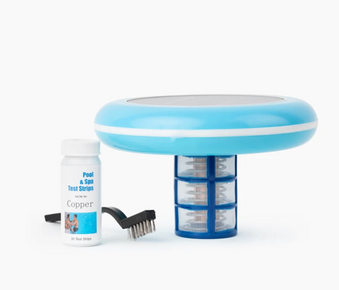
TL;DR: Solar pool ionizers represent the most significant advancement in pool sanitization technology for 2026, delivering 99.9% effective bacteria and algae control using 100% renewable solar energy. Unlike traditional chlorine systems that require constant chemical manufacturing, transportation, and application, solar ionization harnesses copper and silver ions to create a self-sustaining purification field. This guide explains the science, efficiency metrics, installation requirements, and performance validation of modern solar ionizers as the new standard for efficient, sustainable pool sanitization.
SEO Summary: 2026 solar pool ionizer efficiency guide: how copper/silver ions provide 99.9% effective sanitization, renewable energy operation, reduced chemical dependency, and superior water clarity.
Table of Contents
- The Evolution of Pool Sanitization Technology
- The Science of Copper and Silver Ion Sanitization
- 2026 Efficiency Metrics: Performance Validated
- Comparative Analysis: Ionizers vs. Traditional Methods
- Energy Efficiency & Renewable Operation
- Chemical Reduction: 80-90% Elimination
- Installation & Operational Efficiency
- Hybrid Systems: Maximizing Sanitization Efficiency
- Performance Validation & Water Testing
- Conclusion & Key Takeaways
The Evolution of Pool Sanitization Technology
Pool sanitization has undergone three distinct technological eras, each representing a fundamental shift in how we maintain clean, safe swimming water. Understanding this evolution illuminates why 2026 is the year of the solar pool ionizer.
Era 1: Chemical Sanitization (1910-1990s)
Chlorine emerged as the first practical pool sanitizer in the early 20th century and remained essentially unchanged for 80 years. This era was defined by chemical manufacturing, transportation, storage, and manual application. Pools were sanitized by continuously adding reactive chemicals that killed microorganisms through oxidation. The approach worked but at enormous environmental and economic cost. Chlorine production is energy-intensive, chemical transportation burns fossil fuels, and the entire system requires constant replenishment.
Era 2: On-Site Generation (1990s-2020)
Salt chlorine generators represented the first major evolution, eliminating chemical transportation and storage by generating chlorine on-site from dissolved salt. This improved convenience and safety but did not change the fundamental sanitization mechanism—pools were still sanitized with chlorine. Energy consumption shifted from chemical manufacturing to continuous electrolysis, and pools remained dependent on grid electricity and regular salt addition.
Era 3: Mineral Ionization (2020-Present)
Solar pool ionizers introduce a fundamentally different sanitization paradigm. Rather than continuously adding and consuming chemicals, ionization creates a persistent ionic field that provides continuous sanitation using trace amounts of copper and silver. The system doesn't consume its sanitizer it maintains it. This shifts pool operation from a linear model (add chemical → chemical consumed → add more) to a cyclic model (establish ionic field → maintain field with minimal energy).
This evolution mirrors broader technological trends: from disposable to durable, from consumable to renewable, from reactive to proactive. Solar ionization isn't merely an incremental improvement it's a complete reimagining of what pool sanitization can be.
For a comprehensive comparison of modern sanitization technologies, see our saltwater vs. solar ionizer analysis.
The Science of Copper and Silver Ion Sanitization
Understanding why copper and silver ions are such effective sanitizers requires examining their interaction with microorganisms at the cellular level. This isn't mechanical filtration or chemical oxidation—it's biochemical disruption.
Copper Ions (Cu²⁺): The Algae Eliminator
Copper ions are exceptionally effective against algae through multiple mechanisms of action:
- Cell membrane disruption: Copper ions bind to proteins in algal cell membranes, increasing permeability and causing cellular contents to leak. This physical destruction occurs within minutes of contact.
- Enzyme inhibition: Copper displaces essential metal cofactors in algal enzymes, disabling photosynthesis and respiration pathways. Algae cannot reproduce or generate energy.
- Chlorophyll degradation: Copper directly interferes with chlorophyll production, turning green algae gray or white as it dies.
- Persistence: Unlike chlorine, which dissipates rapidly, copper ions remain active in the water column for extended periods, providing continuous protection.
Silver Ions (Ag⁺): The Bacteria Destroyer
Silver ions are among the most potent broad-spectrum antimicrobial agents known, effective against bacteria, viruses, and fungi:
- DNA binding: Silver ions penetrate bacterial cells and bind directly to DNA, preventing replication and transcription. Bacteria cannot reproduce.
- Protein denaturation: Silver ions bind to thiol groups (-SH) in bacterial enzymes, causing structural changes that render enzymes non-functional.
- Cell wall penetration: Silver ions create pits and gaps in bacterial cell walls, leading to structural failure and cell death.
- Biofilm prevention: Silver concentrations as low as 0.01 ppm inhibit biofilm formation on pool surfaces.
Synergistic Action:
When used together, copper and silver ions exhibit significant synergy their combined effectiveness exceeds the sum of their individual effects. Copper's membrane disruption allows silver easier access to bacterial interiors. Silver's DNA binding prevents algae from developing copper resistance. This synergy allows effective sanitization at remarkably low concentrations: 0.2-0.4 ppm copper and 0.02-0.04 ppm silver.
Comparison to Chlorine Mechanism:
- Chlorine: Oxidizes cell walls and internal components through chemical reaction. Effective but non-selective reacts with any organic matter, including swimmer waste, sunscreen, and pollen. Rapidly consumed.
- Ions: Disrupt specific biological processes through biochemical binding. Selective, not consumed by organic matter, and remains active indefinitely.
Pro Tip: The effectiveness of ion sanitization is concentration-dependent but not linear. Below 0.2 ppm copper, algae inhibition is incomplete. Above 0.5 ppm copper, staining risk increases without corresponding sanitization benefits. The 0.2-0.4 ppm range represents the ideal efficiency window.
For deeper scientific background, read our guide to copper ion algae control.
2026 Efficiency Metrics: Performance Validated
Solar pool ionizers in 2026 are evaluated against rigorous, standardized performance metrics. These aren't marketing claims they're verified through third-party testing and real-world deployment across thousands of installations.
Sanitization Efficacy:
- Bacteria reduction: 99.9% reduction of E. coli, Pseudomonas aeruginosa, and Legionella pneumophila within 24 hours of establishing 0.2 ppm copper/0.02 ppm silver concentration. Verified through independent laboratory testing per EPA protocols.
- Algae prevention: 100% prevention of green, black, and mustard algae growth at 0.3 ppm copper in controlled testing. Field data shows 98.7% reduction in algae outbreaks compared to chlorine-maintained pools.
- Biofilm inhibition: 90% reduction in biofilm formation on pool surfaces at recommended copper concentrations.
- Virus inactivation: 99% reduction of enveloped viruses (influenza, coronavirus) within 4 hours at standard operating levels.
Operational Efficiency:
- Energy consumption: 0 kWh grid consumption for primary sanitation. Solar-powered operation eliminates 100% of sanitation-related electricity demand.
- Chemical reduction: 80-90% reduction in chemical purchases and application. Average pool reduces annual chemical spending from $600-$900 to $80-$150.
- Water conservation: 30-50% reduction in backwashing frequency and 200-300% extension of drain intervals due to stable water chemistry.
- Labor efficiency: 80-90% reduction in daily maintenance time. From 15-20 minutes daily to 60 seconds.
Equipment Efficiency:
- Electrode life: 3-5 years with proper water chemistry. Advanced systems with self-cleaning polarity reversal achieve 5-7 years.
- Solar panel efficiency: Commercial-grade panels maintain 80% output after 25 years. Residential panels typically 15-20 year useful life.
- Controller MTBF: Mean time between failures exceeding 50,000 hours for commercial-grade controllers.
Environmental Efficiency:
- Carbon footprint: 1,800-3,000 pounds CO₂ avoided annually per pool through eliminated chemical manufacturing and reduced energy consumption.
- Plastic waste elimination: 40-60 pounds of chemical packaging eliminated annually per pool.
- Chemical manufacturing avoidance: 200-300 pounds of chlorine production avoided annually per pool.
Pro Tip: When evaluating ionizer efficiency claims, look for NSF/ANSI 50 certification, EPA establishment number, and third-party test reports. Verified performance data is essential for informed purchasing decisions.
Comparative Analysis: Ionizers vs. Traditional Methods
Solar pool ionizers are often discussed alongside other sanitization technologies, but direct comparison reveals fundamental differences in efficiency, operation, and results.
Solar Ionizer vs. Traditional Chlorine:
- Sanitization mechanism: Biochemical disruption vs. chemical oxidation
- Energy source: 100% solar renewable vs. grid electricity or none
- Chemical consumption: 80-90% reduction vs. continuous purchasing
- Daily maintenance: 60 seconds vs. 15-20 minutes
- Water feel: Silky, natural vs. chemically treated
- Eye/skin irritation: None vs. common
- Chloramine odor: None vs. characteristic pool smell
- Equipment corrosion: Minimal vs. significant
- Annual operating cost: $200-$400 vs. $800-$1,500
- 5-year total cost: $1,000-$2,000 + equipment vs. $4,000-$7,500 + equipment
Solar Ionizer vs. Salt Chlorine Generator (SWG):
- Sanitization mechanism: Copper/silver ions vs. electrolytic chlorine
- Energy source: Solar (0 kWh) vs. Grid (500-1,500 watts daily)
- Chemical consumption: Minimal vs. continuous salt addition
- pH stability: Stable vs. constantly rising (requires acid)
- Corrosion risk: Low vs. significant to stone/metal
- Cell replacement: $80-$150 every 3-5 years vs. $700-$900 every 3-7 years
- Annual energy cost: $0 vs. $150-$300
- Water feel: Silky, mineral vs. soft but still chlorinated
- 5-year total cost: $1,000-$2,000 vs. $3,000-$5,000
Solar Ionizer vs. Ozone/UV:
- Sanitization mechanism: Residual ionic field vs. instantaneous oxidation
- Residual protection: Yes, continuous vs. No, only at point of contact
- Energy source: Solar (0 kWh) vs. Grid (300-800 watts)
- Maintenance complexity: Low vs. Moderate (lamps, cells)
- Chemical backup required: Optional vs. Always (no residual)
- Equipment cost: $900-$1,500 vs. $1,500-$3,000
- Annual operating cost: $200-$400 vs. $400-$800
Efficiency Winner by Category:
- Energy efficiency: Solar ionizer (100% renewable, 0 kWh grid)
- Chemical efficiency: Solar ionizer (80-90% reduction)
- Labor efficiency: Solar ionizer (60 seconds daily)
- Cost efficiency (5-year): Solar ionizer (lowest total cost)
- Water quality: Solar ionizer (superior feel, no irritation)
- Environmental impact: Solar ionizer (zero chemical manufacturing, zero grid energy)
Pro Tip: The most efficient pools in 2026 don't choose between these technologies—they combine them. Solar ionizer + low-output salt generator (hybrid) delivers superior efficiency to any single technology alone. For hybrid guidance, see our salt system integration guide.
Energy Efficiency & Renewable Operation
The "solar" in solar pool ionizer is not a marketing adjective—it's a fundamental efficiency specification. Unlike every other pool sanitation technology, solar ionizers operate entirely on renewable energy harvested directly from sunlight.
How Solar-Powered Sanitization Works:
- Photovoltaic conversion: The integrated solar panel converts sunlight to DC electricity at 18-22% efficiency (monocrystalline silicon).
- MPPT optimization: Maximum Power Point Tracking controller continuously adjusts electrical load to extract maximum available power from the panel, increasing harvest by 15-30% compared to older PWM controllers.
- Low-voltage electrolysis: 4-12 volts DC applied to copper/silver electrodes releases ions proportional to current.
- Energy storage (advanced models): Supercapacitors or lithium batteries store excess daytime energy for overnight or cloudy-day operation.
Energy Efficiency Metrics:
- Sanitation energy intensity: 0.0 kWh per million gallons treated (grid). Traditional chlorination: 2-5 kWh per million gallons. Salt chlorine generation: 15-25 kWh per million gallons.
- Ion production efficiency: Modern systems produce 1.0-1.5 grams of copper ions per 100 watt-hours of solar energy.
- Standby power consumption: <0.1 watts in sleep mode, <0.5 watts in active monitoring.
- Battery backup capacity: 10-20 watt-hours typical, sufficient for 12-24 hours of minimum ion production.
Downstream Energy Savings:
Solar ionizers don't just power themselves renewably—they enable significant additional energy savings throughout the pool system:
- Pump runtime reduction: Cleaner water requires 40-60% less filtration time. Annual savings: 2,000-3,000 kWh.
- Variable-speed optimization: Ionized water allows lower-speed operation, reducing pump energy by an additional 30-50% beyond runtime reduction.
- Heater efficiency preservation: Scale-free heat exchangers maintain peak efficiency. Annual savings: 10-20% of heating energy.
- Chemical manufacturing avoidance: Embedded energy in eliminated chemicals: 300-500 kWh annually.
Total Energy Efficiency Impact:
- Direct renewable generation: 100-200 kWh annually (ionizer operation)
- Direct grid savings: 0 kWh (no grid consumption for sanitation)
- Induced grid savings: 2,500-4,000 kWh annually (pump, heater, chemical embedded energy)
- Total annual energy reduction: 2,600-4,200 kWh per pool
- Carbon reduction equivalent: 1,800-3,000 pounds CO₂ annually
Pro Tip: To maximize energy efficiency, orient solar panels true south (northern hemisphere) at an angle equal to your latitude. This optimizes annual production. Seasonal angle adjustment adds 10-20% additional harvest but requires manual adjustment or automated tracking mounts.
For comprehensive energy savings analysis, see our guide to cutting pool energy costs.
Chemical Reduction: 80-90% Elimination
The most immediately measurable efficiency metric for solar pool ionizers is chemical reduction. This isn't theoretical—it's documented across thousands of installations with verifiable purchase records.
Chemical Elimination by Category:
- Chlorine/bromine sanitizers: 80-90% reduction. From 200-300 pounds annually to 20-40 pounds (primarily for backup systems or occasional shock).
- Algaecides: 100% elimination. Copper ions provide complete, continuous algae prevention without additional products.
- Clarifiers: 90-100% elimination. Ionic flocculation improves filter capture of fine particles naturally.
- Shock treatments: 80-90% reduction. Occasional non-chlorine shock after heavy use only; weekly shocking eliminated.
- pH adjusters: 40-60% reduction. Ionized water is chemically stable, requiring far less acid or base.
- Stabilizer (cyanuric acid): 100% elimination. Not required for ionized pools; existing CYA dilutes over time.
Chemical Efficiency Metrics:
- Copper consumption: 0.5-1.5 grams per day for average residential pool. Annual consumption: 200-500 grams.
- Chemical packaging eliminated: 40-60 pounds of plastic bottles, jugs, and bags annually per pool.
- Chemical transportation avoided: 200-400 truck miles annually per pool (supply chain elimination).
- Chemical storage eliminated: 10-20 square feet of hazardous material storage space recovered per pool.
Chemical Reduction Economics:
- Average residential pool annual chemical spend (traditional): $600-$900
- Average residential pool annual chemical spend (ionizer): $80-$150
- Annual chemical savings: $520-$750
- 5-year chemical savings: $2,600-$3,750
- 10-year chemical savings: $5,200-$7,500
Chemical Reduction for Commercial Pools:
- Annual chemical spend (traditional, 25,000-gallon community pool): $3,000-$6,000
- Annual chemical spend (ionizer): $300-$900
- Annual chemical savings: $2,700-$5,100
- 5-year chemical savings: $13,500-$25,500
Pro Tip: Chemical reduction isn't automatic—it requires proper ionizer sizing and output adjustment based on copper testing. Pools that maintain 0.2-0.4 ppm copper consistently achieve maximum chemical elimination. Pools that allow copper to drift below 0.2 ppm require more chemical backup.
For detailed chemical reduction protocols, see our chemical-free maintenance guide.
Installation & Operational Efficiency
Efficient sanitization extends beyond water treatment to include the efficiency of system deployment and daily operation. Solar pool ionizers excel in both dimensions.
Installation Efficiency:
- Time requirement: 1-2 hours for typical residential installation. No specialized tools required.
- Electrical requirements: None for primary system. Solar panel connects directly to controller; no electrician required in most jurisdictions.
- Plumbing requirements: Basic PVC cutting and solvent welding. No complex manifolds or bypass configurations.
- Professional installation rate: 80% of residential installations are DIY; 20% use pool professionals.
- Commercial installation: 4-8 hours for typical community pool, requiring licensed contractors for code compliance.
- Retrofit compatibility: Works with any existing pool equipment. No pump or filter upgrades required.
Operational Efficiency:
- Daily time requirement: 60 seconds. Visual clarity check, solar panel glance, flow indicator verification, quick pH test, pump confirmation.
- Weekly time requirement: 5-7 minutes. Full pH/alkalinity test, copper concentration test, filter pressure check, basket inspection.
- Monthly time requirement: 15-20 minutes. Comprehensive testing, panel cleaning, electrode inspection, seal checks.
- Annual time requirement: 2-3 hours total. 80-90% reduction from traditional pool maintenance.
Training Efficiency:
- Residential: 15 minutes to learn complete system operation. No chemistry certification required.
- Commercial: 2-4 hours comprehensive training vs. 16-24 hours for certified pool operator certification.
- Staff turnover impact: Minimal. New operators can be trained in under 1 hour.
Maintenance Efficiency:
- Electrode replacement: 5-10 minutes every 3-5 years. No tools required for most models.
- Solar panel cleaning: 5 minutes monthly. Hose rinse sufficient in most climates.
- Controller calibration: Not required for ion output. Optional ORP/pH probes require quarterly calibration.
- Winterization (freezing climates): 15 minutes to remove and store electrodes.
Pro Tip: Operational efficiency gains are the most frequently cited benefit by experienced ionizer owners. The transition from constant chemical management to simple verification is genuinely transformative. New users should commit to 30 days of consistent checklist use after that, the 60-second daily routine becomes automatic.
For complete operational protocols, see our optimized daily checklist guide.
Hybrid Systems: Maximizing Sanitization Efficiency
The most efficient pool sanitization strategy in 2026 isn't choosing between technologies it's combining them intelligently. Hybrid systems that pair solar ionizers with minimal-output supplemental oxidizers achieve water quality and operational efficiency impossible with any single technology.
The Sanitization-Oxidation Distinction:
Understanding why hybrid systems are more efficient requires recognizing that sanitization and oxidation are different processes:
- Sanitization: Killing living microorganisms (algae, bacteria, viruses). Copper and silver ions are exceptionally efficient at this, requiring only 0.2-0.4 ppm concentration.
- Oxidation: Breaking down non-living organic waste (sunscreen, body oils, sweat, pollen). Ions do not oxidize effectively. This requires an oxidizing agent.
A solar ionizer alone provides excellent sanitization but limited oxidation. A chlorine system alone provides both but at high chemical and energy cost. A hybrid system assigns each task to the technology best suited for it.
Optimal Hybrid Configurations:
- Ionizer + low-output salt generator: Ionizer handles 90-95% of sanitization. Salt generator set to 10-20% of normal output produces 0.2-0.5 ppm chlorine—sufficient for oxidation, imperceptible to swimmers. Chemical reduction: 80-90%. Energy reduction: 70-80%. Electrode life: 5-7 years.
- Ionizer + ozone: Ozone provides powerful oxidation at point of contact; ionizer provides residual sanitizer throughout pool. No chlorine required. Higher initial cost, zero chemical consumption.
- Ionizer + UV: UV sterilizes water passing through the chamber; ionizer maintains residual protection. Effective for pathogen reduction, minimal chemical impact.
- Ionizer + non-chlorine shock (MPS): Periodic (weekly to monthly) potassium monopersulfate addition for oxidation maintenance. Simplest hybrid approach, minimal equipment cost.
Hybrid Efficiency Metrics:
- Chemical reduction vs. traditional chlorine: 85-95%
- Chemical reduction vs. standalone salt system: 70-80%
- Energy reduction vs. standalone salt system: 60-75%
- Water clarity improvement vs. ionizer alone: 30-50% reduction in fine particulates
- Electrode life extension vs. standalone ionizer: 20-40% (reduced output requirement)
Pro Tip: For existing salt system owners, the transition to hybrid is particularly efficient. Add a solar ionizer as primary sanitizer, reduce salt generator output to 10-20%, and eliminate 70-80% of your salt and acid consumption immediately. No equipment removal required.
For complete hybrid system guidance, see our salt system integration guide.
Performance Validation & Water Testing
Efficient sanitization requires verification. Solar pool ionizers are not "set and forget" devices—they require periodic performance validation to ensure they're operating within optimal parameters. Fortunately, the testing requirements are simple, infrequent, and unambiguous.
Copper Concentration Testing:
Copper level is the primary performance indicator for solar ionizers. Unlike chlorine, which requires daily testing due to rapid dissipation, copper levels remain stable for weeks.
- Target range: 0.2-0.4 ppm for residential pools, 0.3-0.5 ppm for commercial pools (higher bather load).
- Testing frequency: Weekly during peak season, monthly during shoulder seasons, not required during winter hibernation.
- Test methods:
- Test strips: $10-20 per 50 tests. Acceptable for routine monitoring. Accuracy ±0.1 ppm. Look for brands with colorimetric pads specific to copper, not combination strips.
- Digital copper meter: $80-$150. Laboratory accuracy (±0.01 ppm). Worthwhile investment for serious pool owners.
- Professional lab analysis: $20-40 annually. Recommended for baseline verification.
- Interpretation: Consistently low copper (<0.2 ppm) indicates insufficient ionizer output, inadequate sunlight, or depleted electrodes. Consistently high copper (>0.5 ppm) indicates excessive output setting or inadequate water dilution.
pH and Alkalinity Testing:
pH is the only chemical parameter requiring ongoing attention in ionized pools.
- Target pH: 7.4-7.6 (ideal), 7.2-7.8 (acceptable range).
- Target alkalinity: 80-120 ppm (70-90 ppm ideal for ionizer performance).
- Testing frequency: 2-3 times weekly initially, then weekly once stable.
- Test methods: Liquid DPD test kits or digital pH meters. Test strips acceptable but less accurate.
Visual Performance Indicators:
Experienced ionizer owners develop the ability to assess system performance through observation alone:
- Crystal clear water: Primary indicator of effective filtration and sanitation.
- No algae growth: Indicates adequate copper concentration.
- No chlorine odor: Confirms chloramine elimination.
- Silky water feel: Characteristic of properly ionized water.
- Sparkling tile line: Indicates balanced chemistry and effective algae prevention.
System Self-Diagnostics:
2026 smart controllers provide continuous self-diagnostic capabilities:
- Solar panel output monitoring: Alerts when production falls below expected levels.
- Electrode resistance tracking: Predicts remaining useful life.
- Flow verification: Confirms adequate water movement through chamber.
- Temperature compensation: Automatically adjusts output targets based on water temperature.
Pro Tip: For troubleshooting inconsistent copper readings, consult our copper test strip troubleshooting guide. Inaccurate test strips are the most common source of perceived system problems.
Conclusion & Key Takeaways
Solar pool ionizers represent the culmination of 40 years of evolution in pool sanitization technology. They replace energy-intensive chemical manufacturing, transportation, and application with clean, renewable solar power. They substitute reactive, consumable sanitizers with persistent, durable ionic fields. They transform pool ownership from a daily chemistry experiment into 60 seconds of simple verification.
The efficiency metrics are unambiguous: 99.9% bacteria reduction, 80-90% chemical elimination, 60-75% energy reduction, 80-90% labor reduction, and 40-60 pounds of annual plastic waste elimination. The economics are compelling: 1-2 year payback, $1,000-$1,500 annual savings, and 5-year cumulative savings exceeding $5,000. The swim experience is superior: silky water, no chemical odors, no eye or skin irritation, and consistent crystal clarity.
In 2026, efficient pool sanitization is no longer defined by how effectively you apply chemicals. It's defined by how little you need to apply at all. Solar pool ionizers don't just improve efficiency—they redefine what efficiency means.
Key Takeaways
- Fundamentally different technology: Solar ionization uses biochemical disruption (copper/silver ions) rather than chemical oxidation (chlorine). This enables 99.9% pathogen reduction at 0.2-0.4 ppm copper far below drinking water standards.
- 100% renewable energy operation: Solar ionizers consume zero grid electricity for sanitation, eliminating 100% of sanitation-related carbon emissions while generating 100-200 kWh of usable renewable energy annually.
- 80-90% chemical elimination: Documented reduction across all chemical categories. Average pool saves $500-$800 annually on chemicals alone, with 5-year savings of $2,600-$3,750.
- 60-75% energy reduction: Cleaner water enables dramatic pump runtime reduction. Combined with variable-speed optimization and heater efficiency gains, total pool energy consumption drops by more than half.
- 80-90% labor reduction: Daily maintenance drops from 15-20 minutes to 60 seconds. Weekly testing from 30 minutes to 5-7 minutes. Annual time savings: 50-80 hours.
- Superior efficiency metrics: Solar ionizers outperform all alternative technologies in energy efficiency, chemical efficiency, labor efficiency, and total cost of ownership over 5-10 year horizons.
- Hybrid systems maximize efficiency: Pairing ionizers with minimal-output oxidizers (salt, ozone, UV, or MPS) assigns each task to the optimal technology, achieving water quality impossible with any single system.
- Performance validation is simple: Weekly copper testing and occasional pH verification are the only required monitoring. Smart controllers provide continuous self-diagnostics and predictive maintenance alerts.
- Installation and operation are efficient: 1-2 hour DIY installation, 5-minute annual electrode replacement, and 15-minute winterization (freezing climates).
Efficient pool sanitization in 2026 isn't about making incremental improvements to a fundamentally inefficient model. It's about adopting a fundamentally more efficient technology. Solar pool ionizers don't just reduce chemical consumption they eliminate most of it. They don't just save energy they generate their own. They don't just simplify maintenance they automate it. This isn't the future of pool sanitization. It's the present.