En bref : Une piscine verte indique une prolifération d'algues causée par de faibles niveaux d'assainissant, une mauvaise circulation ou une filtration inadéquate. La récupération nécessite une action immédiate : tester et équilibrer la chimie de l'eau, choquer la piscine à 10-30 ppm de chlore selon la gravité, brosser toutes les surfaces vigoureusement, faire fonctionner le filtre en continu et aspirer les algues mortes. Ce guide complet couvre l'évaluation, les protocoles de traitement pour les algues légères à sévères, les stratégies de prévention et la manière dont les ioniseurs solaires de piscine préviennent les futures proliférations d'algues. Apprenez comment nettoyer une piscine verte et retrouver rapidement une eau cristalline.
Résumé SEO :
Découvrez quoi faire lorsque votre piscine devient verte grâce à ce guide complet de récupération pour 2026. Apprenez à évaluer la gravité des algues, les protocoles de traitement choc, les techniques de brossage et de filtration appropriées, la restauration de l'équilibre chimique et les stratégies de prévention à l'aide d'ioniseurs solaires. Comprend des instructions étape par étape pour les piscines vertes légères, modérées et sévères, des conseils de dépannage, des estimations de coûts et des méthodes de prévention des algues à long terme pour maintenir une eau cristalline toute l'année.
Table des matières
- Comprendre pourquoi les piscines deviennent vertes
- Évaluation de la gravité des algues
- Actions immédiates à prendre
- Protocoles de traitement par gravité
- Soins et surveillance post-traitement
- Stratégies de prévention
- Solution d'ionisation solaire
- Réflexions finales et recommandations
- Points clés à retenir
Comprendre pourquoi les piscines deviennent vertes
Une piscine verte est le résultat d'une prolifération d'algues – des organismes végétaux microscopiques qui se multiplient rapidement lorsque les conditions sont favorables. Comprendre les causes permet de prévenir la récurrence après le traitement.
Ce qui cause les algues
Les algues sont toujours présentes en petit nombre dans l'eau de la piscine, mais elles restent invisibles et inoffensives lorsque les niveaux d'assainissant sont adéquats. L'eau verte se produit lorsque la population d'algues explose en raison d'un assainissant insuffisant (chlore, brome ou alternative), d'une mauvaise circulation de l'eau créant des zones mortes, d'une filtration inadéquate permettant aux algues de prospérer, de niveaux élevés de phosphates fournissant de la nourriture aux algues, de températures d'eau chaudes (au-dessus de 27°C) accélérant la croissance, ou de fortes pluies diluant les produits chimiques et introduisant des nutriments.
Types d'algues vertes
Vert clair (stade précoce) : L'eau a une légère teinte verdâtre mais vous pouvez toujours voir le fond. Cela indique une prolifération d'algues précoce relativement facile à traiter. Les algues sont flottantes (planctoniques) et ne se sont pas encore attachées aux surfaces.
Vert moyen : L'eau est distinctement verte et la visibilité du fond est limitée à 1 à 1,2 mètre. Les algues se sont multipliées de manière significative et peuvent commencer à s'attacher aux parois et au sol. Le traitement nécessite un choc et un brossage plus agressifs.
Vert foncé (sévère) : L'eau est opaque, vert foncé ou marécageuse, avec une visibilité nulle. Les algues ont formé d'épaisses colonies sur toutes les surfaces. Cela nécessite le protocole de traitement le plus intensif et peut prendre 3 à 7 jours pour s'éclaircir complètement.
Pourquoi cela se produit rapidement
Les algues peuvent rendre une piscine claire verte en seulement 24 à 48 heures dans des conditions idéales. Une seule cellule d'algue peut se diviser toutes les 8 à 12 heures, ce qui signifie qu'une cellule devient des millions en quelques jours. Cette croissance exponentielle explique pourquoi les piscines peuvent passer de claires à vertes apparemment du jour au lendemain, surtout après une panne d'équipement, une négligence pendant les vacances ou de fortes tempêtes. Comprendre comment prévenir les algues est crucial pour éviter cette situation.
Préoccupations concernant la santé et la sécurité
Les piscines vertes ne sont pas sûres pour la baignade. Les algues elles-mêmes ne sont généralement pas nocives, mais elles indiquent un niveau d'assainissant nul dans l'eau, ce qui signifie que les bactéries et les agents pathogènes peuvent prospérer sans contrôle. Les algues rendent également les surfaces glissantes, créant des risques de glissade et de chute. De plus, vous ne pouvez pas voir le fond, ce qui rend impossible de repérer les nageurs en détresse. Ne jamais autoriser la baignade dans une piscine verte tant qu'elle n'a pas été correctement traitée et que les niveaux d'assainissant n'ont pas été rétablis.
Évaluation de la gravité des algues
Une évaluation correcte détermine l'intensité du traitement nécessaire et fixe des attentes réalistes quant au temps de récupération.
Évaluation visuelle
Piscine vert clair :
- L'eau a une légère teinte verdâtre ou un voile
- On peut voir clairement le fond dans la partie peu profonde
- On peut voir à 1,8-2,4 mètres de profondeur dans la partie profonde
- Les parois peuvent être légèrement glissantes mais pas d'algues visibles
- Temps de récupération : 24-48 heures
- Exigence de choc : 10-15 ppm de chlore
Piscine vert moyen :
- L'eau est distinctement verte partout
- On peut voir le fond dans la partie peu profonde mais pas dans la partie profonde
- Visibilité limitée à 0,9-1,2 mètre
- Les parois sont visqueuses et peuvent présenter des taches vertes
- Temps de récupération : 2-4 jours
- Exigence de choc : 20-25 ppm de chlore
Piscine vert foncé/noir :
- L'eau est opaque, vert foncé, brune ou noire
- On ne peut pas voir le fond à aucune profondeur
- Visibilité zéro sous la surface
- Épais revêtement d'algues sur toutes les surfaces
- Peut présenter des débris, des feuilles ou des problèmes d'eau stagnante
- Temps de récupération : 4-7 jours
- Exigence de choc : 30+ ppm de chlore
Tests chimiques
Testez la chimie de l'eau pour comprendre l'étendue complète du problème. Le chlore libre sera probablement de 0 ppm (les algues ont consommé tout le chlore disponible), le pH peut être élevé (la photosynthèse des algues augmente le pH), l'alcalinité peut être hors de portée, les phosphates sont probablement élevés (source de nourriture pour les algues) et le chlore combiné (chloramines) peut être élevé en raison de la matière organique morte. Ces lectures guideront votre approche de traitement et les ajouts chimiques.
Vérification de l'équipement
Inspectez l'équipement de la piscine pour identifier les facteurs contributifs. Vérifiez si la pompe fonctionne correctement et pendant un nombre d'heures adéquat par jour, si le filtre est propre et fonctionne (les filtres sales ne peuvent pas éliminer les algues), si les jets de refoulement fonctionnent correctement (un faible débit indique des problèmes de circulation) et si les paniers de skimmer sont dégagés (les paniers obstrués réduisent la circulation). Résolvez tout problème d'équipement avant ou pendant le traitement pour obtenir les meilleurs résultats.
Actions immédiates à prendre
Suivez ces étapes immédiatement après avoir découvert une piscine verte, avant de commencer le protocole de traitement complet.
Arrêter la baignade
Fermez immédiatement la piscine aux nageurs. Affichez des panneaux si nécessaire pour empêcher quiconque d'entrer dans l'eau. L'eau verte indique un assainissant nul et des risques potentiels pour la santé. La baignade peut également remuer les algues et rendre le traitement plus difficile.
Enlever les débris
Utilisez une épuisette ou un skimmer pour enlever tous les débris visibles : feuilles, brindilles, insectes et matières flottantes. Cette matière organique nourrit les algues et consomme du chlore pendant le traitement. Plus la piscine est propre avant le traitement choc, plus le traitement sera efficace. Ne pas aspirer encore – vous remueriez les algues et risqueriez de boucher le filtre.
Nettoyer les paniers du skimmer et de la pompe
Videz et nettoyez tous les paniers du skimmer et le panier de la crépine de la pompe. Des paniers obstrués réduisent la circulation et l'efficacité de la filtration, toutes deux critiques pour le traitement des algues. Vérifiez les paniers quotidiennement pendant le traitement, car ils se rempliront rapidement d'algues mortes.
Contre-laver ou nettoyer le filtre
Commencez par un filtre propre pour une efficacité maximale. Contre-lavez soigneusement les filtres à sable ou à diatomées, ou nettoyez complètement les filtres à cartouche. Vous devrez nettoyer le filtre plusieurs fois pendant le traitement, il est donc essentiel de commencer avec un filtre propre. Comprendre comment la circulation favorise un bon entretien aide à optimiser ce processus.
Tester la chimie de l'eau
Testez le pH, l'alcalinité, le chlore et les phosphates si possible. Enregistrez ces lectures de base pour suivre les progrès. Ne vous inquiétez pas encore de l'équilibre parfait – vous ajusterez la chimie dans le cadre du protocole de traitement. La priorité est de comprendre d'où vous partez.
Rassembler les fournitures
Avant de commencer le traitement, assurez-vous d'avoir suffisamment de choc (hypochlorite de calcium ou chlore liquide), d'algicide (facultatif mais utile), de réducteur de pH (les algues augmentent le pH), de trousse de test ou de bandelettes, d'une brosse de piscine rigide et de patience (le traitement prend du temps). Calculez la quantité de choc dont vous aurez besoin en fonction du volume de la piscine et de la gravité des algues – il vaut mieux en avoir trop que de manquer au milieu du traitement.
Protocoles de traitement par gravité
Suivez le protocole approprié en fonction de votre évaluation de la gravité des algues. Ne sautez pas d'étapes et ne précipitez pas le processus.
Protocole pour piscine vert clair
Jour 1 :
- Ajustez le pH à 7,2-7,4 à l'aide d'un réducteur de pH (un pH plus bas rend le chlore plus efficace)
- Brossez vigoureusement toutes les surfaces de la piscine : parois, fond, marches, coins, derrière les échelles
- Ajoutez du choc pour augmenter le chlore à 10-15 ppm (généralement 1 à 1,5 kg pour 10 000 gallons)
- Ajoutez un algicide selon les instructions de l'étiquette (facultatif mais accélère la récupération)
- Faites fonctionner le filtre en continu pendant 24 heures
- Brossez à nouveau la piscine le soir
Jour 2 :
- Testez le chlore ; il devrait toujours être à 5 ppm ou plus ; ajoutez plus de choc s'il est inférieur à 5 ppm
- Brossez à nouveau toutes les surfaces
- Contre-lavez ou nettoyez le filtre (il sera sale d'algues mortes)
- Continuez à faire fonctionner le filtre en continu
- L'eau devrait s'éclaircir et passer du vert au bleu-blanc trouble
Jour 3 :
- L'eau devrait être claire ou presque claire
- Passez l'aspirateur dans la piscine pour éliminer les algues mortes déposées au fond
- Nettoyez à nouveau le filtre après l'aspirateur
- Testez et équilibrez toute la chimie (pH, alcalinité, chlore)
- Reprenez le programme de filtration normal
- La piscine devrait être propice à la baignade une fois que le chlore descend à 3 ppm ou moins
Protocole pour piscine vert moyen
Jour 1 :
- Ajuster le pH à 7,2 (limite inférieure pour une efficacité maximale du choc)
- Brosser toute la piscine minutieusement, ceci est essentiel pour briser les colonies d'algues
- Ajouter du choc pour élever le chlore à 20-25 ppm (typiquement 2-2,5 kg pour 10 000 gallons)
- Ajouter de l'algicide à double dose d'entretien normale
- Faire fonctionner le filtre en continu
- Brosser à nouveau la piscine 4 à 6 heures plus tard
Jour 2 :
- Tester le chlore ; il devrait être à 10 ppm ou plus ; ajouter plus de choc s'il est inférieur à 10 ppm
- Brosser toutes les surfaces vigoureusement 2 à 3 fois au cours de la journée
- Contre-laver ou nettoyer le filtre (il sera très sale)
- Continuer à faire fonctionner le filtre en continu
- L'eau devrait passer du vert au gris-bleu trouble
Jour 3 :
- Tester le chlore et ajouter plus de choc s'il est inférieur à 5 ppm
- Brosser à nouveau les surfaces de la piscine
- Nettoyer à nouveau le filtre
- L'eau devrait être trouble mais plus verte
- Continuer à faire fonctionner le filtre en continu
Jour 4 :
- L'eau devrait s'éclaircir considérablement
- Passer l'aspirateur dans la piscine pour évacuer si possible (contourne le filtre), ou passer l'aspirateur vers le filtre et nettoyer immédiatement après
- Nettoyer soigneusement le filtre
- Tester et équilibrer toute la chimie
- Ajouter un clarifiant si l'eau est encore légèrement trouble
Jour 5 :
- L'eau devrait être claire
- Équilibre et ajustement finaux de la chimie
- Reprendre le programme de filtration normal
- Piscine baignable une fois que le chlore est à 3 ppm ou moins
Protocole pour piscine très verte/sévère
Jour 1 :
- Abaissez le pH à 7,0-7,2 pour une efficacité maximale du choc
- Brossez toute la piscine extrêmement minutieusement, passez 30 à 45 minutes à brosser chaque surface
- Ajoutez du choc pour augmenter le chlore à plus de 30 ppm (généralement 3 à 4 kg pour 10 000 gallons)
- Ajoutez un algicide à triple dose d'entretien
- Faites fonctionner le filtre en continu
- Brossez à nouveau la piscine le soir
- Ne vous attendez à aucune amélioration visible le jour 1
Jour 2 :
- Testez le chlore ; il devrait être à plus de 15 ppm ; ajoutez plus de choc pour maintenir plus de 20 ppm
- Brossez toutes les surfaces 3 à 4 fois au cours de la journée
- Lavez à contre-courant ou nettoyez le filtre 2 à 3 fois (il se bouchera rapidement avec les algues mortes)
- Continuez à faire fonctionner le filtre en continu
- L'eau peut commencer à montrer un léger changement de couleur, passant du vert foncé au vert plus clair
Jour 3 :
- Ajoutez plus de choc pour maintenir plus de 15 ppm de chlore
- Brossez les surfaces de la piscine 2 à 3 fois
- Nettoyez le filtre 2 à 3 fois
- L'eau devrait passer du vert au bleu-gris trouble
- Continuez à faire fonctionner le filtre en continu
Jour 4-5 :
- Continuez le traitement choc quotidien pour maintenir plus de 10 ppm de chlore
- Brossez la piscine quotidiennement
- Nettoyez le filtre quotidiennement (éventuellement deux fois par jour)
- L'eau devrait s'éclaircir progressivement
- Au jour 5, l'eau devrait être trouble mais plus verte
Jour 6-7 :
- Aspirez la piscine pour évacuer d'énormes quantités d'algues mortes
- Remplissez la piscine au niveau approprié
- Nettoyez soigneusement le filtre
- Testez et équilibrez toute la chimie
- Ajoutez un clarifiant si nécessaire pour l'éclaircissement final
- La piscine devrait être claire et propice à la baignade au jour 7
Soins et surveillance post-traitement
Une fois que l'eau est claire, un suivi approprié empêche le retour immédiat des algues et assure une récupération complète.
Première semaine après le traitement
- Testez le chlore quotidiennement et maintenez 3-5 ppm (plus élevé que l'entretien normal)
- Testez le pH tous les 2-3 jours et maintenez-le entre 7,4 et 7,6
- Brossez les surfaces de la piscine 2-3 fois au cours de la semaine
- Nettoyez le filtre en milieu de semaine pour éliminer toute algue morte restante
- Faites fonctionner le filtre 12-16 heures par jour (plus longtemps que la normale)
- Surveillez tout signe de retour des algues (légère teinte verte, parois glissantes)
Deuxième semaine après le traitement
- Testez le chlore tous les 2-3 jours, maintenez 2-3 ppm
- Testez le panneau chimique complet (pH, alcalinité, dureté calcique, stabilisant)
- Équilibrez tous les paramètres qui sont hors de portée
- Brossez la piscine chaque semaine
- Reprenez le programme de filtration normal (8-10 heures par jour)
- Envisagez d'ajouter des mesures préventives (voir la section Stratégies de prévention)
Entretien du filtre
Votre filtre a fait des heures supplémentaires pendant le traitement et a besoin d'attention. Pour les filtres à sable, effectuez un lavage à contre-courant approfondi et envisagez d'ajouter un nettoyant pour filtre. Pour les filtres à diatomées, effectuez un nettoyage en profondeur et ajoutez de la nouvelle poudre de diatomées. Pour les filtres à cartouche, nettoyez en profondeur avec un nettoyant pour filtre et un tuyau, en remplaçant les cartouches si elles sont vieilles ou endommagées. Un filtre propre et efficace est essentiel pour prévenir le retour des algues.
Stabilisation chimique
Après un choc agressif et des ajouts chimiques, la chimie de l'eau peut être déséquilibrée. Testez et ajustez le pH à 7,4-7,6, l'alcalinité à 80-120 ppm, la dureté calcique à 200-400 ppm et le stabilisant (acide cyanurique) à 30-50 ppm. Une eau équilibrée est plus résistante à la croissance des algues et plus facile à entretenir. Apprenez-en davantage sur le maintien de la stabilité de l'eau de piscine.
Stratégies de prévention
Prévenir les piscines vertes est beaucoup plus facile et moins coûteux que de les traiter. Mettez en œuvre ces stratégies pour éviter les futures proliférations d'algues.
Maintenir un assainissant adéquat
Le facteur le plus important dans la prévention des algues est le maintien de niveaux d'assainissant constants. Testez le chlore 2 à 3 fois par semaine et maintenez 1 à 3 ppm de chlore libre. Ne laissez jamais le chlore tomber à zéro, même pendant quelques heures. Si vous êtes souvent absent ou si vous avez du mal à maintenir des niveaux de chlore constants, envisagez des distributeurs de chlore automatiques ou des générateurs de chlore au sel pour une désinfection sans effort.
Circulation adéquate
Faites fonctionner votre pompe 8 à 10 heures par jour pendant la saison de baignade, et plus de 12 heures pendant les fortes chaleurs estivales. Une bonne circulation empêche les zones mortes où les algues se colonisent et distribue l'assainissant uniformément dans toute la piscine. Dirigez les jets de refoulement légèrement vers le bas et vers l'extrémité opposée de la piscine pour créer des flux circulaires qui atteignent toutes les zones.
Brossage régulier
Brossez les parois, les marches et le fond de la piscine chaque semaine, même lorsque l'eau semble claire. Le brossage déloge les spores d'algues avant qu'elles ne puissent s'attacher et se multiplier, maintient les surfaces lisses et moins propices aux algues, et distribue l'assainissant sur toutes les surfaces. Portez une attention particulière aux coins, derrière les échelles et aux autres zones à faible circulation.
Traiter régulièrement
Traitez votre piscine chaque semaine pendant la haute saison (juin-août), toutes les 2 semaines pendant la saison intermédiaire (avril-mai, septembre-octobre) et mensuellement hors saison si la piscine reste ouverte. Le traitement choc oxyde les contaminants organiques, détruit les chloramines et fournit un coup de pouce de chlore qui tue les algues émergentes avant qu'elles ne deviennent visibles.
Contrôle des phosphates
Testez les phosphates mensuellement et utilisez un éliminateur de phosphates si les niveaux dépassent 500 ppb. Les phosphates sont la nourriture des algues ; plus il y a de phosphates dans votre eau, plus les algues peuvent pousser rapidement. Les phosphates pénètrent dans les piscines par le ruissellement d'engrais, les feuilles et les débris organiques, certains produits chimiques pour piscine et l'eau de remplissage. Maintenir les phosphates à un faible niveau rend votre piscine beaucoup plus résistante aux proliférations d'algues.
Entretien du filtre
Nettoyez ou lavez à contre-courant votre filtre régulièrement en fonction des lectures du manomètre (généralement lorsque la pression augmente de 8 à 10 psi au-dessus de la ligne de base propre). Un filtre sale ne peut pas éliminer les spores d'algues et leur permet de recirculer. Nettoyez en profondeur les filtres tous les mois pendant la haute saison à l'aide de produits de nettoyage de filtre pour éliminer les huiles et les débris incrustés qui réduisent l'efficacité.
Solution Ioniseur Solaire
Les ioniseurs solaires de piscine offrent l'une des solutions à long terme les plus efficaces pour prévenir les piscines vertes et réduire la charge d'entretien chimique.
Comment les ioniseurs préviennent les algues
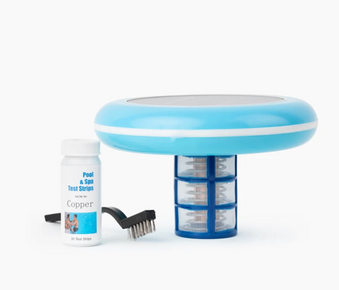
Les ioniseurs solaires comme le modèle de capacité standard libèrent des ions cuivre et argent dans l'eau de la piscine. Les ions cuivre ciblent spécifiquement les algues au niveau cellulaire, perturbant la photosynthèse et empêchant la reproduction. Cela crée un environnement hostile pour les algues qui prévient les proliférations avant qu'elles ne commencent. Apprenez-en davantage sur la façon dont les ioniseurs solaires aident à la prévention des algues.
Avantages pour la prévention des piscines vertes
Les ioniseurs offrent une protection anti-algues 24h/24 et 7j/7 sans attention quotidienne, réduisent les besoins en chlore de 50 à 85 % (moins de gestion chimique), fonctionnent en continu même lorsque vous êtes absent ou oubliez d'ajouter des produits chimiques, et sont alimentés par l'énergie solaire avec des coûts de fonctionnement nuls. Les propriétaires de piscine utilisant des ioniseurs signalent pratiquement aucun problème d'algues, même pendant la chaleur estivale maximale lorsque la pression des algues est la plus élevée.
Choisir le bon ioniseur
Sélectionnez un ioniseur dimensionné de manière appropriée pour le volume de votre piscine. Pour les piscines de 10 000 à 35 000 gallons, le modèle standard offre une excellente couverture. Pour les piscines plus grandes de 35 000 à 45 000 gallons et plus, choisissez l'unité haute capacité. Pour les très grandes piscines, envisagez un ensemble d'ioniseurs pour une protection complète.
Installation après le traitement de la piscine verte
Attendez que votre piscine soit complètement claire et que la chimie soit équilibrée avant d'installer un ioniseur. Assurez-vous que le chlore est à des niveaux normaux (1 à 3 ppm), que le pH est de 7,2 à 7,6 et que l'eau est limpide sans algues. Installez l'ioniseur conformément aux instructions du fabricant, en le positionnant pour qu'il reçoive 6 à 8 heures d'ensoleillement direct par jour. Testez les niveaux d'ions cuivre chaque semaine à l'aide de bandelettes de test, en visant 0,2 à 0,4 ppm pour une prévention optimale des algues.
Prévention des algues à long terme
Avec un ioniseur correctement entretenu, vous pouvez réduire la fréquence de choc à mensuelle (au lieu de hebdomadaire), abaisser les niveaux de chlore à 0,5-1,5 ppm (au lieu de 1-3 ppm) et éliminer complètement les achats d'algicide. L'ioniseur fournit une protection de fond continue pendant que vous maintenez un minimum de chlore pour le contrôle des bactéries et des virus. Cette approche s'aligne sur les stratégies d'assainissement de piscine plus intelligentes qui minimisent les produits chimiques tout en maximisant l'efficacité.
Comparaison des coûts
Le traitement d'une piscine verte coûte 50 à 200 $ en produits chimiques (choc, algicide, clarifiant) plus beaucoup de temps et d'efforts. Un ioniseur solaire de qualité coûte 150 à 400 $, mais il prévient indéfiniment les piscines vertes tout en réduisant les coûts chimiques annuels de 300 à 800 $. L'ioniseur est rentabilisé en une saison et continue d'offrir de la valeur pendant des années. Si l'on tient compte du temps, de la frustration et des dommages potentiels aux équipements liés au traitement des piscines vertes, la proposition de valeur est convaincante.
Réflexions finales et recommandations
Une piscine verte est frustrante et inesthétique, mais elle est tout à fait récupérable avec la bonne approche. La clé est d'agir rapidement, d'utiliser un choc adéquat, de brosser soigneusement et de maintenir une filtration continue jusqu'à ce que l'eau s'éclaircisse. Ne lésinez pas sur les moyens et ne précipitez pas le processus, un traitement approprié prend du temps mais donne des résultats complets.
Évaluez honnêtement la gravité de vos algues et suivez le protocole approprié. Les piscines vert clair s'éclaircissent en 1 à 2 jours avec un effort modéré, tandis que les piscines vert foncé sévères nécessitent 5 à 7 jours de traitement intensif. Fixez-vous des attentes réalistes et engagez-vous à suivre le protocole complet plutôt que d'abandonner à mi-parcours.
N'oubliez pas que le traitement d'une piscine verte n'est que la première étape. Sans s'attaquer aux causes sous-jacentes (désinfectant insuffisant, mauvaise circulation ou entretien peu fréquent), la piscine redeviendra verte. Utilisez le processus de récupération comme motivation pour mettre en œuvre de meilleures pratiques d'entretien et des mesures préventives à l'avenir.
Pour la prévention des algues à long terme, les ioniseurs solaires offrent la solution la plus fiable et la moins exigeante en entretien disponible en 2026. Des unités de qualité comme l'ioniseur de piscine solaire RiverPure ou l'ioniseur de piscine solaire LUXTOR offrent une protection continue contre les algues qui prévient les piscines vertes même pendant les vacances, les pannes d'équipement ou les périodes de négligence. L'investissement dans un ioniseur est bien inférieur au coût cumulatif du traitement de multiples épisodes de piscine verte au fil des ans.
Une fois votre piscine claire, maintenez des niveaux de désinfectant constants, faites fonctionner votre pompe de manière adéquate, brossez chaque semaine et choquezz régulièrement. Ces habitudes simples, combinées à un ioniseur pour l'assurance, vous garantissent de ne plus jamais avoir de piscine verte. Les principes des pratiques de nettoyage de piscine respectueuses de l'environnement mettent l'accent sur la prévention plutôt que sur le traitement, une approche qui permet d'économiser du temps, de l'argent et de la frustration.
Ne laissez pas une piscine verte vous décourager de posséder une piscine. Avec les bonnes connaissances et les bons outils, maintenir une eau cristalline est simple et gérable. Agissez dès aujourd'hui, suivez le protocole de traitement adapté à votre situation et mettez en œuvre des stratégies de prévention pour que votre piscine reste d'un bleu étincelant tout au long de la saison.
Points clés à retenir
- Les piscines vertes indiquent une prolifération d'algues due à un désinfectant insuffisant : évaluez la gravité en fonction de la visibilité (vert clair : on voit clairement le fond ; vert moyen : visibilité limitée ; vert foncé : visibilité nulle) pour déterminer l'intensité du traitement approprié et le temps de récupération.
- Le traitement nécessite un choc agressif : le vert clair nécessite 10 à 15 ppm de chlore (récupération en 2 à 3 jours), le vert moyen nécessite 20 à 25 ppm (4 à 5 jours) et le vert foncé nécessite 30+ ppm (5 à 7 jours) – ne lésinez pas sur le choc, sinon le traitement échouera.
- Le brossage est essentiel au succès : brossez toutes les surfaces vigoureusement 2 à 4 fois par jour pendant le traitement pour briser les colonies d'algues, les exposer au chlore et les empêcher de se cacher dans les fissures ou derrière l'équipement.
- Faites fonctionner le filtre en continu pendant le traitement et nettoyez/lavez à contre-courant 1 à 3 fois par jour selon la gravité – les filtres sales ne peuvent pas éliminer les algues mortes et ralentiront considérablement la récupération, pouvant potentiellement entraîner l'échec du traitement.
- Ne laissez jamais le chlore tomber en dessous de 5 ppm pendant le traitement : testez quotidiennement et ajoutez plus de choc si nécessaire pour maintenir le pouvoir de destruction ; les algues peuvent récupérer et se multiplier si le chlore descend trop bas avant que le traitement ne soit terminé.
- La prévention est plus facile que le traitement : maintenez 1 à 3 ppm de chlore en permanence, faites fonctionner la pompe 8 à 10 heures par jour, brossez chaque semaine, choquezz régulièrement et contrôlez les phosphates pour prévenir de futures proliférations d'algues et éviter de répéter le processus de traitement.
- Les ioniseurs solaires assurent une prévention des algues à long terme grâce à la libération continue d'ions cuivre (0,2 à 0,4 ppm), réduisant les besoins en chlore de 50 à 85 %, éliminant le besoin d'algicide et prévenant les piscines vertes même pendant les vacances ou en cas de panne d'équipement – l'investissement est rentabilisé en une saison.
En suivant ces étapes clés — évaluation précise des algues, choc agressif, brossage assidu, filtration continue et mesures préventives, y compris les ioniseurs solaires — vous pouvez restaurer efficacement les piscines vertes et maintenir une eau claire et saine toute l'année. La constance et un entretien adéquat sont essentiels pour prévenir les futures proliférations et assurer un environnement de baignade sans algues et nécessitant peu d'entretien.