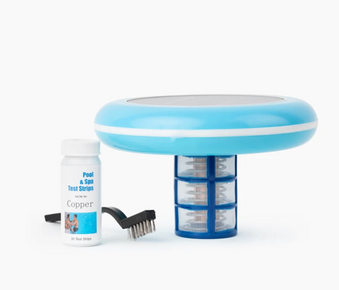
Solar Pool Ionizer for Pools With Filter Strain in 2026

Page Top Background Banner
Solar Pool Ionizer for Pools With Filter Strain in 2026


TL;DR: Filter strain is one of the most common and frustrating issues for pool owners, manifesting as rapidly rising pressure, frequent cleaning requirements, and diminished water clarity. Solar pool ionizers address filter strain at its source through ionic flocculation, which causes fine particles to clump together for more efficient capture. This natural process reduces the load on filters, extends cleaning intervals, and improves overall filtration performance. This guide explores how solar ionization alleviates filter strain, the mechanisms behind particle agglomeration, and practical strategies for optimizing filtration in ionized pools.

SEO Summary: 2026 guide to solar pool ionizer for pools with filter strain: ionic flocculation, reduced particle load, extended cleaning intervals, and improved filtration efficiency.

Understanding Filter Strain

Filter strain is a term that encompasses several related problems: rapidly rising filter pressure, the need for frequent cleaning, diminished water flow, and poor water clarity despite adequate filtration. Understanding what causes filter strain is the first step toward addressing it effectively with solar ionization.

  • Filter pressure rises as particles accumulate in the filter media. Clean filters have a baseline pressure, typically measured right after cleaning. As the filter captures particles, pressure increases. When pressure rises 8 to 10 PSI above baseline, the filter needs cleaning. Rapid pressure rise indicates a high particle load.
  • Frequent cleaning is both inconvenient and wasteful. Cartridge filters that need cleaning every week instead of every month consume owner time and may wear out faster. Sand filters that require backwashing every few days waste water and effort.
  • Diminished water flow affects the entire circulation system. As filter pressure rises, flow through the system decreases. This reduces skimmer effectiveness, slows water movement, and can stress the pump.
  • Poor clarity despite adequate filtration suggests that particles are too small to be captured. Microscopic particles in the 1 to 10 micron range can pass through most filter media, creating haze even when the filter is clean and operating properly.
  • Particle sources are numerous. Dust, pollen, dead skin cells, sunscreen residue, algae spores, and organic debris all contribute to the particle load. In traditional pools, many of these particles remain suspended because they are too small to be filtered.
  • Chemical additions can actually increase particle load. Clarifiers work by clumping particles, but they add chemicals to the water. Algaecides kill algae, but the dead cells must still be filtered. Each chemical addition introduces its own challenges.

Solar pool ionizers address filter strain through a fundamentally different approach that works with the filtration system rather than against it. The comprehensive solar pool ionizer vs traditional systems in 2026 comparison explains why ionization is more effective at managing particle loads.

How Ionic Flocculation Reduces Filter Load

Ionic flocculation is the primary mechanism by which solar pool ionizers reduce filter strain. This natural process causes microscopic particles to clump together, making them large enough to be captured by standard pool filters.

  • The process begins with particle charging. Most suspended particles in pool water dust, pollen, dead skin cells, and organic debris carry a negative surface charge. This negative charge causes particles to repel each other, keeping them suspended and too small to be captured by filters.
  • Copper ions released by the ionizer carry a positive charge. They are naturally attracted to the negatively charged particles. When copper ions bind to particle surfaces, they neutralize the repulsive charges.
  • Particle agglomeration follows charge neutralization. With their surface charges neutralized, particles no longer repel each other. They begin to collide and stick together, forming larger clusters called floc. These clusters can be 10 to 100 times larger than the original particles.
  • Filtration capture becomes dramatically more effective once particles have agglomerated. Standard pool filters can capture these enlarged clusters, removing contaminants that would otherwise pass through the filter media. This is why ionized pools achieve clarity that chlorinated water cannot match.
  • The process is continuous and self-sustaining. As long as copper concentrations are maintained within the target range of 0.2 to 0.4 parts per million, particles are constantly being conditioned for filtration. The filter continuously removes them, keeping the water clear.
  • No chemical clarifiers are needed. Ionic flocculation outperforms chemical clarifiers while adding no chemicals to the water. The process is natural and requires no owner intervention.

Ionic flocculation is one of the most powerful tools for reducing filter strain. The discussion of transforming water stability through a solar pool ionizer in 2026 explores how stable chemistry supports consistent flocculation.

The Science of Particle Charges

Understanding the science behind particle charges helps explain why ionic flocculation is so effective and why traditional pools struggle with fine particles.

  • Surface charges on particles come from their chemical composition. Most organic and inorganic particles in pool water develop negative surface charges when suspended in water. This is due to the ionization of surface groups and the adsorption of ions from the water.
  • Repulsive forces between like-charged particles keep them separated. Because all particles carry the same negative charge, they repel each other. This repulsion prevents them from coming close enough to stick together, keeping them suspended as individual microscopic particles.
  • Filter limitations are directly related to particle size. Most pool filters are designed to capture particles above a certain size threshold. Cartridge filters typically capture particles down to 10 to 20 microns. Sand filters capture down to 20 to 40 microns. DE filters capture down to 3 to 5 microns. Particles smaller than these thresholds pass through.
  • Copper ions provide the positive charge needed to neutralize particles. When copper ions bind to particle surfaces, they neutralize the negative charge, eliminating the repulsive force. This allows particles to approach each other and agglomerate.
  • Agglomeration size depends on particle concentration and contact opportunities. In well-maintained ionized pools, particles continuously agglomerate into clusters large enough for any filter type to capture.
  • The process is self-regulating. As particles are removed by the filter, the particle concentration decreases, but the continuous conditioning ensures that new particles entering the pool are promptly agglomerated.

The science of particle charges explains why ionic flocculation is so effective. The simpler pool chemistry solar pool ionizer 2026 resource demonstrates how this elegant mechanism replaces multiple chemical additives.

Measurable Improvements in Filtration Efficiency

The benefits of ionic flocculation are not just theoretical they can be measured and quantified. Understanding these metrics helps pool owners appreciate the real-world impact of solar ionization on filter strain.

  • Capture efficiency for fine particles improves dramatically. Traditional filters capture 40 to 60 percent of particles in the 1-10 micron range per pass. Ionized pools achieve 80 to 90 percent capture efficiency for the same particle range. This means that for the same filtration energy, an ionized pool removes two to three times more contaminant mass.
  • Particle loading on filters becomes more uniform. Because particles are agglomerated into clusters, they form a more permeable cake on filter surfaces. This allows water to flow through more easily, resulting in slower pressure rise for the same particle mass captured.
  • Filter runtime between cleanings extends by 30 to 50 percent. A cartridge filter that required cleaning every 4 weeks in a chlorinated pool might go 6 to 8 weeks in an ionized pool. This reduction in cleaning frequency saves time and extends media life.
  • Backwash frequency for sand and DE filters decreases by a similar margin. Less frequent backwashing saves water and reduces maintenance time. The water saved adds up over the course of a season.
  • Water clarity improves measurably. The same filtration system produces visibly clearer water because it is actually removing more contaminants. The jewel-like sparkle of ionized water is the visible result of superior filtration efficiency.
  • Pump energy can be reduced because filtration is more efficient. With the same or better clarity achieved in less time, pump runtime can often be reduced, saving energy and further reducing filter loading.

Measurable improvements in filtration efficiency translate directly to reduced filter strain. The how solar pool ionizer boosts pool efficiency in 2026 quantifies these improvements and their impact on overall pool performance.

Benefits by Filter Type

Different filter types benefit from ionic flocculation in different ways. Understanding how your specific filter performs helps you maximize the benefits.

  • Cartridge filters are the ideal match for ionized pools. The enlarged particle clusters load onto cartridge surfaces more efficiently, forming a permeable cake that allows continued flow while capturing particles. Cartridge life typically increases by 30 to 50 percent because the gentler loading causes less media damage. Cleaning intervals extend, and the cartridges themselves last longer.
  • Sand filters also benefit substantially. Flocculated particles are trapped more effectively in the sand bed, and backwashing removes them more completely. Sand quality lasts longer, and channeling is reduced. The result is more consistent filtration and less frequent media replacement.
  • DE filters achieve their highest efficiency with ionized water. The enlarged particles are captured on the DE-coated grids with minimal pressure increase, extending filtration cycles dramatically. DE consumption may decrease because the grids stay cleaner longer. The result is water clarity that approaches distilled water appearance.
  • Multi-cartridge systems become even more convenient. With extended cleaning intervals, having multiple cartridges to rotate becomes less critical, but the ability to clean one while others operate remains valuable during peak particle loads.
  • Backwash water recovery systems, where installed, see reduced load. Less frequent backwashing means less water to treat and recover, improving the efficiency of these systems.
  • Filter media life extension across all types delivers significant cost savings. Cartridges that cost $100 to $200 per set and last 1 to 2 years in chlorinated pools may last 2 to 3 years in ionized pools. Sand that might need replacement every 5 to 7 years can last indefinitely with proper care.

Benefits vary by filter type, but all filters perform better in ionized water. The enhancing pool performance with a solar pool ionizer 2026 resource provides detailed information on optimizing filtration for each filter type.

Extended Cleaning Intervals

Extended cleaning intervals are one of the most appreciated practical benefits of solar ionization. Less time spent cleaning filters means more time enjoying the pool.

  • Typical cleaning intervals in ionized pools extend by 30 to 50 percent compared to chlorinated pools. This is not a one-time improvement it persists as long as copper levels are maintained in the target range.
  • Cartridge filters that required cleaning every 3 to 4 weeks may go 5 to 6 weeks between cleanings. During heavy use periods like summer, intervals may shorten slightly, but they remain longer than in chlorinated pools.
  • Sand filters that needed backwashing every 2 to 3 weeks may go 3 to 4 weeks. The actual interval depends on bather load and environmental factors, but the improvement is consistent.
  • DE filters see the most dramatic extension, with cycles potentially doubling. The combination of efficient particle capture and slow pressure rise means DE filters in ionized pools often operate for 6 to 8 weeks between backwashes.
  • Predictable pressure rise allows scheduling rather than reacting. With consistent particle loading, filter pressure rises at a steady, predictable rate. Owners can schedule cleanings on a calendar rather than constantly checking pressure.
  • Seasonal variations still affect intervals. Spring pollen and fall leaf debris may temporarily shorten intervals, but the underlying improvement remains. During these periods, the ionizer's flocculation helps the filter handle the increased load more effectively than in chlorinated pools.

Extended cleaning intervals translate directly to less work and more enjoyment. The solar pool ionizer streamlines modern pool management in 2026 demonstrates how this simplification fits into the bigger picture of effortless pool care.

Filter Pressure and What It Tells You

Filter pressure is one of the most valuable indicators of pool health. Understanding what pressure readings mean in ionized pools helps you optimize filter performance.

  • Clean filter baseline pressure should be recorded after each cleaning. This is the pressure reading with a clean filter at normal operating speed. Knowing this baseline allows you to track filter loading accurately.
  • Pressure rise rate indicates particle load. In ionized pools, pressure typically rises at a steady, predictable rate. A sudden increase in rise rate may indicate an unusual event like an algae bloom, heavy rain, or high bather load.
  • Cleaning threshold is typically 8 to 10 PSI above clean baseline. When pressure reaches this level, filtration efficiency decreases, and it's time to clean. In ionized pools, you can confidently clean based on pressure rather than a fixed schedule.
  • Pressure after cleaning should return to baseline. If it doesn't, the filter may not be fully clean, or there may be an underlying issue with the filter media or system.
  • Comparison to previous cycles reveals long-term trends. If pressure rise accelerates over several cycles, it may indicate that the filter media is degrading or that particle load has permanently increased. If rise rate slows, your water quality may be improving.
  • Pressure gauges themselves need occasional verification. Gauges can stick or drift over time. Comparing to a known good gauge annually ensures your readings are accurate.

Filter pressure monitoring becomes more meaningful in ionized pools because the predictable behavior allows confident interpretation. The operational guidelines for solar pool ionizer in 2026 provide detailed protocols for pressure monitoring and interpretation.

Troubleshooting Persistent Filter Strain

Even with a solar ionizer, occasional filter strain issues can arise. A systematic approach helps identify and resolve the cause quickly.

  • Check copper levels first. If copper is below 0.2 ppm, ionic flocculation may be insufficient to agglomerate particles effectively. Increase ionizer output by 10 percent and retest after 48 hours. If copper is above 0.5 ppm, reduce output to prevent staining.
  • Verify pH is in the optimal range of 7.4 to 7.6. High pH reduces copper effectiveness and can cause precipitation that adds to filter load. Low pH can be aggressive and may indicate other issues.
  • Inspect the filter media itself. Cartridges may be worn or damaged, allowing particles to pass through. Sand may be channeled, reducing effectiveness. DE grids may be torn or coated with insoluble deposits.
  • Test phosphates and treat if above 500 ppb. High phosphates can fuel algae growth that increases particle load even if visible algae aren't present. Phosphate removers may temporarily increase cloudiness but will reduce long-term load.
  • Consider source water quality. If you've added significant make-up water recently, it may contain particles or minerals that are loading the filter. Test fill water and consider pre-filtration if needed.
  • Evaluate pump runtime. If the pump isn't running enough hours, particles may accumulate faster than they can be filtered. During troubleshooting, run continuously for 24 to 48 hours to see if pressure rise slows.
  • Check for dead spots or circulation issues. Areas with poor circulation can accumulate debris that eventually makes its way to the filter. Brushing these areas can release trapped particles for filtration.

Systematic troubleshooting resolves filter strain issues quickly. The bringing predictable pool maintenance with a solar pool ionizer resource provides comprehensive protocols for diagnosing and resolving common problems.

Maintenance Strategies for Optimal Filtration

Beyond the automatic benefits of ionic flocculation, certain maintenance strategies help maximize filtration performance and minimize filter strain.

  • Clean filters thoroughly when needed. For cartridge filters, use a filter cleaner designed to dissolve oils and debris. Spray from the inside out to drive particles off the media. Rinse thoroughly before reinstalling.
  • Rotate cartridges if you have multiple sets. Having a clean set ready to install while the dirty set is being cleaned minimizes downtime and ensures continuous filtration.
  • Backwash sand and DE filters thoroughly. Follow manufacturer recommendations for backwash duration and flow rate. After backwashing, verify that pressure returns to clean baseline.
  • Inspect O-rings and seals during each cleaning. A small leak can bypass the filter, allowing unfiltered water back to the pool. Replace worn seals promptly.
  • Consider a deep cleaning of sand filters annually. Sand can become coated with oils and minerals over time, reducing effectiveness. Commercial sand cleaner or professional service can restore performance.
  • Monitor pressure rise rate between cleanings. A sudden change may indicate developing issues that need attention before they become serious.
  • Record cleaning dates and pressure readings. This data reveals patterns and helps predict future cleaning needs. It also provides valuable information for troubleshooting if problems arise.

Maintenance strategies are simpler in ionized pools but still important. The long-term planning with solar pool ionizer systems in 2026 provides guidance on incorporating filter maintenance into your overall pool care routine.

Conclusion & Key Takeaways

Solar pool ionizers address filter strain at its source through ionic flocculation, which causes microscopic particles to clump together for efficient filtration. This natural process reduces the load on filters, extends cleaning intervals, and improves overall filtration performance.

Measurable improvements include 80 to 90 percent capture efficiency for fine particles, 30 to 50 percent longer cleaning intervals, and visibly clearer water. All filter types benefit cartridge filters last longer, sand filters require less frequent backwashing, and DE filters achieve exceptional efficiency.

Filter pressure becomes a more meaningful indicator in ionized pools because pressure rises at a steady, predictable rate. Owners can schedule cleanings based on pressure rather than reacting to unexpected spikes.

For pools struggling with filter strain, adding a solar ionizer can be transformative. The same filter that required weekly cleaning may go a month or more between cleanings. Water clarity improves dramatically. Maintenance becomes simpler and more predictable.

Key Takeaways

  • Filter strain manifests as rapidly rising pressure, frequent cleaning needs, diminished flow, and poor clarity. Understanding its causes is essential for effective treatment.
  • Ionic flocculation is the primary mechanism by which solar ionizers reduce filter load. Copper ions neutralize particle charges, allowing them to clump into filterable clusters.
  • The science of particle charges explains why traditional pools struggle with fine particles. Negative charges keep particles suspended and too small to filter.
  • Measurable improvements include 80 to 90 percent capture efficiency for fine particles, 30 to 50 percent longer cleaning intervals, and visibly clearer water. The how solar pool ionizer boosts pool efficiency in 2026 quantifies these benefits.
  • All filter types benefit from ionization. Cartridge filters last longer, sand filters backwash less frequently, and DE filters achieve exceptional efficiency.
  • Extended cleaning intervals of 30 to 50 percent are typical. This translates directly to less work and more enjoyment.
  • Filter pressure monitoring becomes more meaningful in ionized pools. Predictable pressure rise allows scheduling rather than reacting.
  • Troubleshooting persistent filter strain should include checking copper levels, pH, filter media condition, phosphates, source water, pump runtime, and circulation.
  • Maintenance strategies remain important but are simpler. Clean filters thoroughly, inspect seals, monitor pressure trends, and record data.
  • Solar pool ionizers transform filter performance. The same filtration system works better, lasts longer, and requires less attention. The solar pool ionizer systems supporting cleaner water in 2026 demonstrates how this contributes to overall water quality.

Every pool owner deserves a filtration system that works efficiently without constant attention. Solar pool ionizers make this achievable by addressing filter strain at its source, allowing your filter to do its job effectively with less effort from you.

Hinterlasse einen Kommentar

x

x