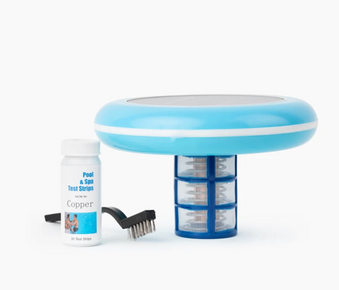
Der Pool-Solarionisierer für Schwimmbecken mit einem Fassungsvermögen von über 170.000 Litern ist für langanhaltende Wasserpflege, Langlebigkeit und maximale Effizienz konzipiert. Er verfügt über eine wetterfeste Polymere-Scheibe, ein fortschrittliches Solarpanel und eine austauschbare Mineralanode aus Kupfer- und Silberlegierung.
Bei Sonneneinstrahlung erzeugt das solarbetriebene Panel einen sicheren, niedrigen Spannungsstrom, der die Anode mit Energie versorgt. Dieser Prozess setzt Kupfer- und Silberionen frei, die im Wasser zirkulieren. Diese natürlichen Mineralien bekämpfen Bakterien und Algen, stoppen das Wachstum auf zellulärer Ebene und halten das Wasser im Gleichgewicht. Im Gegensatz zu herkömmlichen Methoden, die ausschließlich Chlor verwenden, trägt das Pool-Ionisator-System dazu bei, die Klarheit des Wassers zu erhalten und gleichzeitig den Chemikalienverbrauch um bis zu 85 % zu reduzieren.
Diese Ionisator-Technologie für Schwimmbecken verhindert nicht nur Algenwachstum, sondern reduziert auch Verfärbungen und Kalkablagerungen. Durch die Senkung des Chemikalienbedarfs können Poolbesitzer jährlich zwischen 200 und 900 US-Dollar sparen. Für Familien und gewerbliche Betreiber bietet es eine umweltfreundliche, nachhaltige und kostengünstige Lösung für die ganzjährige Pflege.
Inhaltsverzeichnis
- Was ist ein Solar-Pool-Ionisator?
- Wie es funktioniert: Die Wissenschaft hinter der Solar-Ionisierung
- Schritt-für-Schritt-Anleitung zur Verwendung
- Wartungs- und Pflegeanleitung
- Technische Merkmale und Spezifikationen
- Vorteile im Detail
- Kostenanalyse und Einsparungen
- Kompatibilitätsinformationen
- Sicherheitsinformationen
- Fehlerbehebung bei häufigen Problemen
- Warum einen Pool-Solar-Ionisator wählen?
Was ist ein Solar-Pool-Ionisator?
Ein Pool-Ionisator-System ist ein innovativer Ansatz, um Poolwasser auf natürliche Weise klar zu halten. Im Gegensatz zu aggressiven Chemikalien, die regelmäßig hinzugefügt werden müssen, verwendet ein solarbetriebener Ionisator Kupfer- und Silberionisation; eine seit Jahrhunderten bewährte Desinfektionsmethode.
Sobald der Pool-Ionisator im Becken platziert ist, beginnt seine Arbeit sofort. Das schwimmende Gerät absorbiert Sonnenlicht, wandelt es in Niederspannungsstrom um und aktiviert die Kupferelektrode. Diese Elektrode setzt Mineralionen frei, die als natürliches Algizid und Bakterizid wirken. Die Ionen stören den Lebenszyklus von Bakterien und Algen und reduzieren gleichzeitig den Chlorbedarf.
Eine Einheit dieses Ionisators für Pools kann effektiv über 170.000 Liter Wasser behandeln, wodurch er sowohl für private als auch für gewerbliche Pools ideal ist. Durch die ständige Freisetzung von Mineralien hilft der Ionisator, die Wasserchemie stabil zu halten, Bakterien und Viren zu bekämpfen und Algenblüten selbst unter starker Beanspruchung zu verhindern.
Wie es funktioniert: Die Wissenschaft hinter der Solar-Ionisierung
Der Solar-Pool-Ionisator arbeitet nach einem einfachen, aber ausgeklügelten Prinzip der Elektrolyse, angetrieben durch Solarenergie. Der Prozess beginnt, wenn Sonnenlicht auf das fortschrittliche Solarpanel trifft, das in das schwimmende Gerät integriert ist. Dieses Panel wandelt Solarenergie in einen Niederspannungs-Strom um, typischerweise zwischen 4-12 Volt, was für Schwimmer und Poolausrüstung absolut sicher ist.
Dieser elektrische Strom fließt dann durch die austauschbare Mineralanode, die aus einer speziellen Kupfer- und Silberlegierung besteht. Die elektrische Ladung bewirkt, dass Metallionen durch einen Prozess, der als Ionisierung bezeichnet wird, aus der Anode in das Wasser freigesetzt werden. Die Kupfer- und Silberionen sind positiv geladen und verteilen sich aufgrund ihrer elektrischen Eigenschaften und der Wasserzirkulation natürlich im Poolwasser.
Kupferionen zielen speziell auf Algenzellen ab und stören sie auf zellulärer Ebene. Sie durchdringen die Zellwände von Algenorganismen und beeinträchtigen deren photosynthetische Prozesse und Enzymsysteme. Dies verhindert, dass die Algen Energie produzieren, sich vermehren und führt letztendlich zum Zelltod. Die Kupferionen sind besonders wirksam gegen alle gängigen Arten von Poolalgen, einschließlich Grünalgen, Senfalgen und Schwarztalgen.
Silberionen wirken gleichzeitig, um Bakterien und Viren zu eliminieren. Die Silberionen heften sich an bakterielle Zellwände und stören deren Stoffwechselprozesse. Sie binden an essentielle Enzyme und Proteine in den Mikroorganismen und verhindern deren ordnungsgemäße Funktion. Silber hat sich als wirksam gegen eine Vielzahl schädlicher Bakterien wie E. coli, Streptokokken und Legionellen sowie viele gängige Viren erwiesen, die in Poolumgebungen gedeihen können.
Die Kombination aus Kupfer- und Silberionen schafft ein leistungsstarkes, kontinuierliches Desinfektionssystem, das synergetisch mit Ihrer bestehenden Poolpflegeroutine zusammenarbeitet. Die Ionen bleiben über längere Zeiträume im Wasser aktiv und bieten einen kontinuierlichen Schutz zwischen herkömmlichen chemischen Behandlungen. Dieser Dual-Action-Ansatz gewährleistet eine umfassende Wassersanierung und reduziert gleichzeitig die Abhängigkeit des Pools von aggressiven Chemikalien erheblich.

Schritt-für-Schritt-Anleitung zur Verwendung
Erstinstallation und Einrichtung
Schritt 1: Überprüfen Sie die Poolbedingungen. Stellen Sie sicher, dass Ihre Wasserchemie (pH-Wert, Alkalinität, Chlor) ausgewogen ist, bevor Sie den Ionisator hinzufügen. Die idealen Parameter sind ein pH-Wert zwischen 7,2 und 7,6, eine Alkalinität zwischen 80 und 120 ppm und Chlorwerte zwischen 1 und 3 ppm. Ein ausgewogenes Wasser sorgt für eine optimale Leistung des Ionisationsprozesses und verhindert potenzielle Probleme mit Mineralausfällungen oder reduzierter Wirksamkeit.
Schritt 2: Montieren Sie den Pool-Solarionisator gemäß den Anweisungen des Herstellers. Dies beinhaltet normalerweise das Anbringen der Metallfeder am Schwimmkopf, das Einsetzen der Kupferelektrode in die dafür vorgesehene Kammer und das Befestigen des gelben Korbsiebs mit der gelben Schraube. Stellen Sie sicher, dass alle Komponenten richtig sitzen und befestigt sind, um Wasseraustritt oder eine Trennung der Komponenten während des Gebrauchs zu verhindern.
Schritt 3: Platzieren Sie die Ionisator-Schwimmbeckeneinheit im Wasser und lassen Sie sie frei schwimmen. Wählen Sie einen Bereich im Pool, in dem das Gerät den ganzen Tag über maximale Sonneneinstrahlung erhält. Vermeiden Sie Bereiche, die durch Bäume, Gebäude oder andere Strukturen über längere Zeiträume beschattet werden. Das schwimmende Design ermöglicht es dem Ionisator, sich auf natürliche Weise mit den Wasserströmungen zu bewegen, was eine gleichmäßige Verteilung der Ionen im gesamten Pool fördert.
Schritt 4: Stellen Sie sicher, dass das Gerät für beste Leistung volle Sonneneinstrahlung erhält. Das Solarpanel benötigt direktes Sonnenlicht, um ausreichend elektrischen Strom für den Ionisationsprozess zu erzeugen. Positionieren Sie das Gerät so, dass das Solarpanel nach oben zeigt und nicht durch Poolwände, Leitern oder andere Geräte verdeckt wird. Bei begrenzter Sonneneinstrahlung arbeitet der Ionisator mit reduzierter Effizienz, nimmt aber den vollen Betrieb wieder auf, wenn ausreichend Sonnenlicht vorhanden ist.
Betriebsüberwachung und -einstellung
Schritt 5: Nach 12 Stunden Erstbetrieb aktivieren Sie das Reinigungssystem Ihres Pools, um die Verteilung der freigesetzten Ionen im Wasser zu unterstützen. Lassen Sie Ihre Poolpumpe und das Filtersystem in der ersten Woche der Ionisatornutzung täglich mindestens 8-12 Stunden laufen, um eine gründliche Zirkulation und Verteilung der Kupfer- und Silberionen zu gewährleisten.
Schritt 6: Nach 24 Stunden überprüfen Sie das Wasser, um zu bestätigen, dass die Arbeit des Pool-Ionisators korrekt verläuft. Verwenden Sie die mitgelieferten Teststreifen, um den Kupferionengehalt im Wasser zu messen. Die ideale Kupferkonzentration sollte zwischen 0,2 und 0,4 Teilen pro Million (ppm) liegen. Dieser Wert gewährleistet eine effektive Algen- und Bakterienkontrolle und liegt gleichzeitig deutlich unter dem Schwellenwert, der Verfärbungen oder andere Probleme mit der Wasserqualität verursachen könnte.
Schritt 7: Überwachen Sie regelmäßig die Klarheit des Poolwassers und das Algenwachstum. In den ersten zwei Wochen der Nutzung des Solar-Ionisators sollten Sie eine allmähliche Verbesserung der Wasserklarheit und eine Reduzierung des Chlorbedarfs feststellen. Es kann 10-14 Tage dauern, bis die Ionenkonzentration optimale Werte erreicht hat und die vollen Vorteile sichtbar werden.
Schritt 8: Reduzieren Sie Ihren traditionellen Chemikalieneinsatz schrittweise. Wenn der Ionisator beginnt, Algen und Bakterien effektiv zu kontrollieren, können Sie Ihren Chlorverbrauch jede Woche um 10-20 % reduzieren, bis Sie die gewünschte Reduktion von bis zu 85 % erreichen. Überwachen Sie die Wasserqualität während dieser Übergangszeit genau, um sicherzustellen, dass die ordnungsgemäße Desinfektion aufrechterhalten wird.
Wartungs- und Pflegeanleitung
Regelmäßige Reinigungsverfahren
Schritt 5–6: Alle 15 Tage den Ionisator entnehmen und die Elektrode mit der mitgelieferten Bürste reinigen. Regelmäßige Reinigung stellt sicher, dass die Ionen weiterhin gleichmäßig freigesetzt werden. Mit der Zeit können sich Mineralablagerungen und andere Ablagerungen auf der Elektrodenoberfläche ansammeln, was die Effizienz des Ionisationsprozesses verringert.
Um die Elektrode ordnungsgemäß zu reinigen, entfernen Sie zuerst den Solar-Ionisator aus dem Poolwasser. Öffnen Sie die Elektrodenkammer gemäß den Anweisungen des Herstellers, normalerweise durch Abschrauben des gelben Korbsiebs. Bürsten Sie die Kupferelektrode vorsichtig mit der mitgelieferten Reinigungsbürste, um sichtbare Ablagerungen zu entfernen. Vermeiden Sie die Verwendung von Metallbürsten oder Scheuermitteln, die die Elektrodenoberfläche beschädigen könnten.
Bei hartnäckigen Mineralablagerungen können Sie die Elektrode 15-20 Minuten lang in einer Lösung aus einem Teil weißem Essig und vier Teilen Wasser einweichen. Diese milde Säurelösung hilft, Kalzium und andere Mineralsalze aufzulösen, ohne die Kupfer- und Silberlegierung zu beschädigen. Nach dem Einweichen spülen Sie die Elektrode gründlich mit sauberem Wasser ab und bauen die Einheit wieder zusammen.
Überwachung der Wasserqualität
Überprüfen Sie immer wöchentlich die Kupferwerte. Wenn die Werte 0,9 ppm überschreiten, entfernen Sie das Gerät, bis sie unter 0,4 ppm fallen. Dies hält Ihr Wasser im Gleichgewicht und verhindert Trübungen. Hohe Kupferwerte können potenziell zu einem grünlichen Schimmer im Wasser oder zu Verfärbungen auf Pooloberflächen führen, insbesondere in Pools mit Putzoberflächen oder Natursteinelementen.
Verwenden Sie die mitgelieferten Teststreifen oder ein zuverlässiges Poolwasser-Testkit, um die Kupferionenkonzentrationen zu überwachen. Testen Sie jede Woche zur gleichen Zeit, vorzugsweise am späten Nachmittag, wenn die Ionenkonzentrationen aufgrund des kumulativen Tagesbetriebs typischerweise am höchsten sind. Notieren Sie Ihre Testergebnisse, um Trends zu verfolgen und notwendige Anpassungen an Ihrer Wartungsroutine zu identifizieren.
Überwachen Sie zusätzlich zu den Kupferwerten weiterhin die standardmäßigen Poolwasserparameter, einschließlich pH-Wert, Alkalinität, Chlor und Cyanursäure. Der Solar-Ionisator arbeitet am effektivsten, wenn diese Parameter innerhalb ihrer idealen Bereiche gehalten werden. Achten Sie besonders auf den pH-Wert, da ein hoher pH-Wert (über 7,8) die Wirksamkeit von Chlor und Kupferionen verringern kann.

Saisonale Wartung
Während der Badesaison sollten Sie Ihren regelmäßigen 15-tägigen Reinigungsplan und die wöchentliche Wasserprüfung beibehalten. Der Ionisator erfordert in der Regel eine häufigere Reinigung in Gebieten mit hartem Wasser oder hohem Mineralgehalt im Füllwasser.
Zur Überwinterung oder bei längerer Nichtbenutzung nehmen Sie den Solar-Ionisator aus dem Pool, reinigen ihn gründlich und lagern ihn an einem kühlen, trockenen Ort. Vor der Lagerung stellen Sie sicher, dass das Gerät vollständig trocken ist, um Korrosion oder Mineralablagerungen während der Lagerung zu vermeiden. Die Kupferelektrode muss je nach Poolgröße und Wasserbedingungen nach 3-6 Monaten Dauerbetrieb ausgetauscht werden.
Dieser einfache Prozess gewährleistet, dass Ihr Pool-Solar-Ionisator effizient und mit minimalem Aufwand arbeitet und während der gesamten Badesaison eine konstante, zuverlässige Leistung bietet.
Technische Merkmale und Spezifikationen
Das fortschrittliche Design dieses Pool-Ionisator-Systems kombiniert Einfachheit, Nachhaltigkeit und hohe Leistung:
Solarstromsystem
Schwimmt kontinuierlich, angetrieben von der Sonne. Das integrierte hocheffiziente Solarpanel wandelt Sonnenlicht ohne externe Stromquelle in elektrische Energie um. Das Panel ist so konzipiert, dass es auch an teilweise bewölkten Tagen ausreichend Spannung erzeugt, obwohl der Betrieb bei direkter Sonneneinstrahlung am effektivsten ist.
Arbeitet von Sonnenaufgang bis Sonnenuntergang mit hochpräziser Solartechnologie. Das System umfasst fortschrittliche Elektronik, die die Stromerzeugung optimiert und den Ionisierungsprozess basierend auf dem verfügbaren Sonnenlicht reguliert. Dies gewährleistet eine konsistente Ionenfreisetzung während der Tagesstunden, ohne das Wasser während der Spitzenzeiten der Sonne zu übersättigen.
Benötigt keinen Strom, 100 % solarbetrieben. Das vollständig in sich geschlossene Design eliminiert die Notwendigkeit von elektrischen Anschlüssen, Verlängerungskabeln oder Batteriewechseln. Dies vereinfacht die Installation und eliminiert Betriebskosten, die mit dem Stromverbrauch verbunden sind.
Ionisierungstechnologie
Hemmt auf natürliche Weise Algenwachstum mit Kupfer- und Silberionen. Die spezielle Kupfer-Silber-Legierung in der Anode ist für eine kontrollierte, konsistente Ionenfreisetzung konzipiert. Der Kupferanteil zielt hauptsächlich auf Algen ab und verhindert die Photosynthese, während die Silberkomponente eine starke antibakterielle Wirkung bietet.
Bekämpft Bakterien und Viren ohne aggressive Chemikalien. Der Ionisationsprozess schafft eine feindliche Umgebung für Mikroorganismen, ist aber für Schwimmer völlig sicher. Das System ist besonders wirksam gegen gängige Poolverunreinigungen wie E. coli, Pseudomonas und verschiedene Pilzarten.
Hält die Wasserchemie mit minimalen Anpassungen im Gleichgewicht. Durch die Reduzierung des Chlorbedarfs und die kontinuierliche Desinfektion trägt der Ionisator zur Stabilisierung der gesamten Wasserchemie bei. Dies führt zu weniger pH-Schwankungen und einem geringeren Bedarf an chemischen Anpassungen im Vergleich zu herkömmlichen Systemen, die nur Chlor verwenden.
Konstruktion und Design
Sicher und ungiftig; unschädlich für Kinder, Haustiere, Haut und sogar Fische in Teichen. Das Gehäuse besteht aus UV-beständigen, lebensmittelechten Polymeren, die einer kontinuierlichen Exposition gegenüber Sonnenlicht und Poolchemikalien standhalten. Alle Materialien sind ungiftig und umweltverträglich.
Geeignet für Schwimmbäder, Whirlpools, Springbrunnen und Teiche. Das universelle Design funktioniert in verschiedenen aquatischen Umgebungen. Für kleinere Gewässer wie Whirlpools oder Springbrunnen kann eine verkürzte Betriebszeit erforderlich sein, um eine Übermineralisierung zu vermeiden.
Mit seinem effizienten Design bietet das Ionisator-Schwimmbeckensystem täglich Sicherheit und saubereres Wasser. Die langlebige Konstruktion gewährleistet jahrelangen zuverlässigen Betrieb mit minimalen Wartungsanforderungen, abgesehen von der regelmäßigen Elektrodenreinigung und dem gelegentlichen Anodenwechsel.

Vorteile im Detail
Die Wahl eines Pool-Solarionisierers bringt sowohl kurz- als auch langfristige Vorteile mit sich:
Sofortige Vorteile
Schnelle Wirkung: Mineralionen beginnen innerhalb von Stunden, Bakterien und Algen zu stören. Während sich die vollständige Schutzbarriere der Ionen erst nach 1-2 Wochen aufbauen kann, beginnt der Ionisationsprozess sofort nach Sonneneinstrahlung. Eine verbesserte Wasserklarheit und ein reduzierter Chlorgeruch können bereits in den ersten Tagen der Anwendung bemerkt werden.
Besseres Schwimmerlebnis: Kristallklares Wasser, kein Chlorgeruch, reduzierte Augen- und Hautirritationen. Die Reduzierung von Chlor- und Chloraminverbindungen führt zu einem Wasser, das sich weicher und natürlicher anfühlt. Schwimmer mit empfindlicher Haut oder Chlorallergien berichten oft von einer deutlichen Verbesserung des Komforts bei der Nutzung ionisierter Pools.
Gesünderes Wasser: Bekämpft Bakterien und Viren auf natürliche Weise und schafft eine sauberere Poolumgebung. Die kontinuierliche Desinfektion durch Kupfer- und Silberionen gewährleistet einen konstanten Schutz zwischen traditionellen chemischen Behandlungen. Dies ist besonders vorteilhaft für stark frequentierte Pools oder während Perioden hoher Temperaturen, die das Bakterienwachstum fördern.
Langfristige Vorteile
Energieeinsparungen: Wird mit Sonnenlicht betrieben, wodurch die Abhängigkeit von Elektrizität reduziert wird. Der vollständig solarbetriebene Betrieb eliminiert den Energieverbrauch, der mit traditionellen Salzchlorinatoren oder anderen elektrisch betriebenen Desinfektionssystemen verbunden ist. Dies kann im Laufe einer Schwimmsaison zu erheblichen Einsparungen bei den Stromrechnungen führen.
Geringere Chemikalienkosten: Reduziert den Chlorbedarf um bis zu 85 %. Die Reduzierung des Chlorverbrauchs stellt erhebliche und kontinuierliche Einsparungen dar, insbesondere angesichts der Volatilität der Chemikalienpreise. Die meisten Benutzer stellen fest, dass ihre Chlorkäufe auf gelegentliche Schockbehandlungen statt auf regelmäßige Wartungszugaben reduziert werden.
Geringerer Wartungsaufwand: Weniger Verschleiß an Filtern und Pumpen im Vergleich zu chemisch belasteten Systemen. Mit reduziertem Algenwachstum und verbesserter Wasserqualität arbeiten Filtersysteme effizienter und erfordern weniger häufige Reinigungen. Pumpendichtungen und andere Komponenten erfahren auch weniger chemischen Abbau, was die Lebensdauer der Ausrüstung potenziell verlängert.
Umweltvorteile
Umweltfreundlich: Eine nachhaltige Alternative zu herkömmlichen Desinfektionsmitteln, die chemische Abfälle reduziert. Durch die Minimierung der Verwendung von industriell hergestellten Chemikalien reduziert der Solarionisator die Umweltauswirkungen, die mit der Chemikalienproduktion, -verpackung und dem Transport verbunden sind. Das System selbst enthält keine gefährlichen Materialien und erzeugt keine Emissionen oder Nebenprodukte außer den natürlichen Mineralionen.
Der konsequente Einsatz dieses Ionisators für Pools sorgt für einen sicheren, funkelnden Pool und spart gleichzeitig Geld und minimiert den täglichen Arbeitsaufwand. Die kumulierten Vorteile schaffen eine Poolpflegeroutine, die einfacher, kostengünstiger und umweltfreundlicher ist als herkömmliche chemieabhängige Ansätze.
Kostenanalyse und Einsparungen
Anfangsinvestition vs. langfristige Einsparungen
Der Pool-Solarionisierer stellt eine moderate Anfangsinvestition dar, die sich typischerweise innerhalb der ersten 1-2 Badesaisons durch reduzierte Chemikalienkosten amortisiert. Während die Anschaffungskosten höher sein mögen als bei einigen traditionellen chemischen Behandlungen, sind die langfristigen Einsparungen erheblich und dauerhaft.
Spart 200 bis 900 US-Dollar pro Jahr an Chemikalienkosten. Die genauen Einsparungen hängen von mehreren Faktoren ab, darunter Poolgröße, aktueller Chemikalienverbrauch, lokale Chemikalienpreise und Länge der Badesaison. Größere Pools und solche in Regionen mit längeren Badesaisonen erzielen typischerweise die größten absoluten Einsparungen.
Reduziert den Chlorverbrauch um bis zu 85 %. Für einen durchschnittlichen privaten Pool, der in der Hochsaison 1-2 Gallonen flüssiges Chlor pro Woche verwendet, kann diese Reduzierung allein bei Chlor 300-600 US-Dollar pro Jahr einsparen. Zusätzliche Einsparungen ergeben sich aus dem geringeren Kauf von Algiziden, Klärern und anderen zusätzlichen Chemikalien.
Zusätzliche finanzielle Vorteile
Verlängerte Lebensdauer der Ausrüstung: Durch die reduzierte chemische Korrosion und Ablagerungen halten Poolpumpen, Filter und Heizungen oft länger, wodurch Austauschkosten, die sich auf Hunderte oder Tausende von Dollar belaufen können, verzögert werden.
Reduzierter Wasserwechsel: Die stabilisierte Wasserchemie und die reduzierte Chemikalienbelastung bedeuten, dass seltener ein teilweiser oder vollständiger Wasserwechsel erforderlich ist, was Wasser- und Chemikalienstartkosten spart.
Geringerer Energieverbrauch: Durch den Wegfall elektrisch betriebener Desinfektionssysteme wie Salzelektrolysegeräte oder Ozonsysteme reduziert der Solarionisierer den Stromverbrauch und trägt so zu zusätzlichen Einsparungen bei den Stromrechnungen bei.
Minimale Wartungskosten: Abgesehen vom gelegentlichen Anodenwechsel (typischerweise alle 3-6 Monate je nach Nutzung) fallen beim Solarionisierer keine wiederkehrenden Kosten für Verbrauchsmaterialien oder Ersatzteile an.
Kompatibilitätsinformationen
Entwickelt für Pools bis zu 170.000 Litern und mehr. Das System ist so konstruiert, dass es sehr große private und gewerbliche Pools effektiv behandeln kann. Für Pools, die deutlich größer als 170.000 Liter sind, können mehrere Einheiten für eine optimale Leistung empfohlen werden.
Kompatibel mit eingelassenen, oberirdischen, Salzwasser-, Chlorpools, Spas und Teichen. Der Ionisierungsprozess funktioniert effektiv mit allen gängigen Pooltypen und Desinfektionssystemen. In Salzwasserpools bietet der Ionisator eine zusätzliche Desinfektion, die die Arbeitslast des Salzelektrolysegeräts reduziert und dessen Lebensdauer potenziell verlängert.
Funktioniert mit allen gängigen Pooloberflächen, einschließlich Putz, Fiberglas, Vinylfolie und lackierten Oberflächen. Pools mit hellen Putz- oder Natursteinoberflächen sollten jedoch die Kupferwerte sorgfältig überwachen, um mögliche Verfärbungen bei erhöhten Konzentrationen zu vermeiden.
Effektiv bei verschiedenen Wasserhärtebedingungen, obwohl sehr hartes Wasser eine häufigere Elektrodenreinigung erfordern kann, um Mineralablagerungen zu entfernen. Das System funktioniert gut über einen weiten pH-Bereich (7,0-8,0), obwohl die optimale Leistung im idealen pH-Bereich von 7,2-7,6 auftritt.
Sicherheitsinformationen
Wassersicherheit
Sicher und ungiftig; unbedenklich für Kinder, Haustiere, Haut und sogar Fische in Teichen. Die vom System freigesetzten Kupfer- und Silberionen liegen in Konzentrationen vor, die für Menschen und Tiere völlig sicher und gleichzeitig wirksam gegen Mikroorganismen sind.
Die Umweltschutzbehörde (EPA) hat festgestellt, dass Kupferwerte bis zu 1,0 ppm und Silberwerte bis zu 0,1 ppm für Trinkwasser sicher sind, während der Ionisator typischerweise Werte weit unter diesen Schwellenwerten bei 0,2-0,4 ppm für Kupfer und noch niedrigere Werte für Silber aufrechterhält.
Schwimmer mit Kupferallergien oder Morbus Wilson (einer seltenen Kupferstoffwechselstörung) sollten vor der Nutzung von kupferionisierten Pools einen Arzt konsultieren, obwohl Reaktionen bei diesen niedrigen Konzentrationen äußerst selten sind.
Betriebssicherheit
Das Niederspannungs-Elektrosystem stellt keine Stromschlaggefahr dar, selbst wenn das Gerät während des Betriebs gehandhabt wird. Alle elektrischen Komponenten sind vollständig im wasserdichten Gehäuse versiegelt.
Das schwimmende Design verhindert unbeabsichtigten Kontakt mit der Elektrode, während das Gerät in Betrieb ist. Die Elektrodenkammer ist so konzipiert, dass die Metallkomponenten sicher umschlossen sind und gleichzeitig Wasserkontakt für die Ionisierung ermöglichen.
Während der Reinigung und Wartung erzeugt das Gerät keinen elektrischen Strom, wenn es aus dem Sonnenlicht entfernt wird, wodurch die vollständige Sicherheit während der Handhabung und des Elektrodenwechsels gewährleistet ist.

Behebung häufiger Probleme
Leistungsprobleme
Wenn das Algenwachstum anhält: Stellen Sie sicher, dass der Ionisator ausreichend Sonnenlicht erhält und die Elektrode sauber und ordnungsgemäß funktioniert. Überprüfen Sie, ob die Kupferwerte im empfohlenen Bereich von 0,2-0,4 ppm liegen. Bei hartnäckigen Algenproblemen zunächst eine traditionelle Algizidbehandlung ergänzen und sich dann auf den Ionisator zur Wartung verlassen.
Wenn das Wasser trüb wird: Überprüfen Sie die Kupferwerte. Konzentrationen über 0,9 ppm können zu Trübungen führen, insbesondere in Pools mit hohem pH-Wert oder hoher Gesamtalkalität. Entfernen Sie den Ionisator vorübergehend und lassen Sie die Werte auf natürliche Weise sinken oder lassen Sie den Pool teilweise ab und füllen Sie ihn wieder auf.
Wenn keine Ionen freigesetzt zu werden scheinen: Vergewissern Sie sich, dass das Solarpanel sauber ist und direktes Sonnenlicht erhält. Überprüfen Sie, ob alle elektrischen Verbindungen im Gerät sicher sind. Überprüfen Sie die Elektrode auf übermäßige Ablagerungen, die die Ionisierung behindern könnten.
Wartungsprobleme
Schneller Elektrodenverbrauch: Dies kann auf einen übermäßig niedrigen pH-Wert (unter 7,0) oder hohe Chlorwerte hinweisen, die beide die Elektrodenkorrosion beschleunigen können. Passen Sie die Wasserchemie an die idealen Parameter an und überwachen Sie die Elektrodenlebensdauer.
Mineralische Verfärbungen: Obwohl bei korrekten Ionenwerten selten, können Verfärbungen auftreten, wenn die Kupferwerte über längere Zeiträume 0,9 ppm überschreiten oder wenn der pH-Wert konstant hoch bleibt. Verwenden Sie bei Verfärbungen Sequestriermittel zur Metallkontrolle und halten Sie das Wasser im Gleichgewicht.
Reduzierte Schwimmfähigkeit: Überprüfen Sie das Eindringen von Wasser in die Schwimmerkammer. Stellen Sie sicher, dass alle Dichtungen und Dichtungsringe richtig positioniert sind und das Gerät korrekt zusammengebaut ist.
Warum einen Pool-Solarionisierer wählen?
In der heutigen Poolpflegebranche suchen Poolbesitzer nach nachhaltigen, kostengünstigen Alternativen, die mit modernen Desinfektionssystemen zusammenarbeiten. Ein Pool-Solarionisierer bietet genau das.
Indem er Sonnenlicht in Energie umwandelt, verteilt der Ionisator kontinuierlich Mineralien, die Bakterien und Algen unter Kontrolle halten. Dieser natürliche Ansatz reduziert die Abhängigkeit von Chlor und schafft eine bessere Schwimmumgebung. Im Gegensatz zu traditionellen reinen Chlormethoden, die oft Hautreizungen, Gerüche und eine instabile Wasserchemie verursachen, bietet die Ionisator-Poolmethode eine stetige, ganztägige Desinfektion.
Die Technologie stellt eine Verschiebung hin zu nachhaltigeren Poolpflegemethoden dar, die den Chemikalieneinsatz minimieren und gleichzeitig eine hervorragende Wasserqualität aufrechterhalten. Da Umweltbedenken und Chemikalienkosten weiter steigen, bietet die Solarionisierung eine praktische Lösung, die mit modernen ökologischen Werten übereinstimmt.
Ob für einen privaten Garten oder eine gewerbliche Einrichtung, dieses Poolionisiersystem ist zuverlässig, skalierbar und effizient. Kommerzielle Betreiber schätzen besonders die konstante Leistung und die erheblichen Einsparungen bei den Chemikalienkosten, die sich im Laufe der Zeit in erheblichen Betriebseinsparungen niederschlagen.
Es ist das bewährte Geheimnis für kristallklares Wasser, weniger Chemikalieneinsatz und langfristige Einsparungen, alles angetrieben von der Sonne. Die Kombination aus sofortigen Vorteilen und langfristigen Vorteilen macht den Solar-Poolionisierer zu einer intelligenten Wahl für jeden Poolbesitzer, der die Wartung vereinfachen, Kosten senken und ein angenehmeres Schwimmerlebnis schaffen möchte.